Knowing how to spot a police drone at night comes down to four things: recognizing red and blue strobe lights, listening for a high-pitched buzzing sound, checking for deliberate hovering or orbiting flight patterns, and using a Remote ID app on your smartphone to confirm the operator.
Strange lights hovering above your neighborhood after dark can be unsettling. Is it a helicopter? A star? Someone's recreational quadcopter? Or is it law enforcement watching from above?
With over 1,500 U.S. police departments now operating drone programs and cities like Las Vegas logging more than 10,000 drone missions per year, the chances of seeing a police drone at night are higher than ever. Drone-as-first-responder programs are expanding rapidly, with the FAA streamlining approvals so agencies can launch in days rather than months.
This guide walks you through practical, step-by-step methods to identify a police drone at night. You will learn what to look for, what to listen for, which tools can help, and what to do once you have confirmed what you are seeing.
Table of contents
- Look for red and blue strobe lights
- Listen for the buzzing sound
- Read the flight pattern
- Use a Remote ID app on your phone
- Know which drone models police actually use
- Rule out other objects in the night sky
- RF detection apps and their limits
- How weather affects your ability to spot a drone
- What to do after you spot a police drone
- Frequently asked questions
Look for red and blue strobe lights
The fastest way to identify a police drone at night is by its lights. All drones flying after dark must carry anti-collision lights visible from at least three statute miles, flashing between 40 and 100 times per minute. That is the FAA baseline for every drone in the sky.
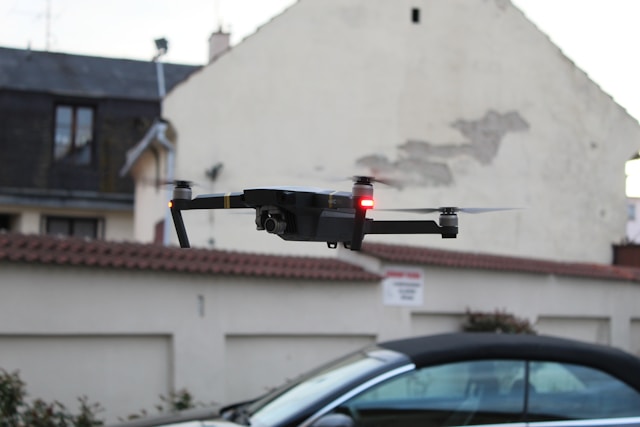
What sets a police drone apart is the addition of red and blue strobes. These emergency colors mirror the light bars on patrol cars and are not used by recreational or commercial operators. If you see a tight cluster of lights with alternating red and blue flashes, you are almost certainly looking at a law enforcement aircraft.
Here is what the standard light configuration looks like on a police drone:
| Light | Position | Purpose |
|---|---|---|
| Red navigation | Left (port) side | Indicates heading |
| Green navigation | Right (starboard) side | Indicates heading |
| White anti-collision strobe | Top or bottom | FAA-required visibility |
| Red and blue strobes | Across airframe | Law enforcement identification |
| Infrared emitters | Near camera | Invisible to naked eye, aids thermal cameras |
From a distance, you may only see one or two of these lights at a time depending on the drone's orientation. A pair of binoculars helps enormously. Even a smartphone camera zoomed in can reveal the alternating red-blue pattern that confirms police operation.
One detail that competitors rarely mention: some police drones also carry downward-facing spotlights or illuminators they activate during search operations. If you see a bright beam sweeping the ground from a hovering light source, that is a strong indicator of an active law enforcement mission rather than a hobbyist flying around.
Listen for the buzzing sound
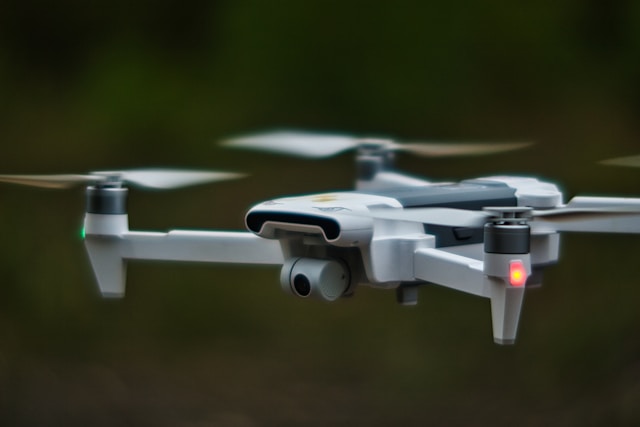
Every multirotor drone produces a distinctive high-pitched buzz from its spinning propellers. At night, when ambient noise drops, you can hear a drone from surprisingly far away. Several hundred feet is typical in a quiet residential area.
The sound is often compared to a swarm of bees or a large electric shaver. It differs sharply from the deep thudding of a helicopter or the steady hum of a fixed-wing aircraft passing overhead.
A few practical tips for audio detection:
- Step outside. Windows and walls muffle the sound significantly.
- Turn off nearby noise sources. Air conditioning units, music, and conversation all mask the buzzing.
- Listen for changes in pitch. A drone that is hovering produces a steady tone. When it accelerates or changes altitude, the pitch shifts noticeably.
- Note the duration. Recreational drones rarely fly for more than 20 to 30 minutes. If you hear buzzing for 40 minutes or longer, the operator likely has battery-swapping infrastructure, which points toward a professional or law enforcement operation.
Sound alone cannot confirm that a drone is police-operated. But combined with light observations, it narrows the possibilities quickly. For more on how drone flight times vary by platform, see our deep dive on the topic.
Read the flight pattern
Police drones fly with purpose. Recreational operators tend to wander, explore, and change direction on a whim. Law enforcement drones follow deliberate, mission-driven patterns that are distinctive once you know what to look for.
Stationary hover. The drone holds position above a single location for an extended period. This is common during active incident response, where the aircraft provides an overhead camera angle to officers on the ground. A surveillance drone hovering for 20 minutes or more is almost never a hobbyist.
Circular orbit. The drone flies repeated loops around a fixed point of interest. This pattern keeps a camera trained on a subject while maintaining different viewing angles. You will see the lights trace a slow, consistent circle in the sky.
Grid search. Systematic back-and-forth sweeps across an area. This is the hallmark of a search-and-rescue mission, where the drone is scanning for a missing person with thermal imaging cameras. The movements are even, methodical, and cover ground in parallel lanes.
Rapid deployment from a fixed point. Many departments now operate drone-in-a-box systems where the aircraft launches from a rooftop docking station automatically when a 911 call comes in. If you see a drone launch from the same rooftop location repeatedly, it is likely a drone-as-first-responder station. Fairfax County, Virginia reported that their DFR drones arrived first at the scene in over 70% of their initial 100 missions, averaging under 90 seconds response time.
These patterns contrast sharply with recreational flight behavior. A hobbyist taking nighttime photos will zip around erratically, hover briefly for a shot, then move to a new angle. The movements lack the repetitive structure of a mission plan. Understanding flight planning fundamentals helps you distinguish planned routes from casual flying.
Use a Remote ID app on your phone
Remote ID is the single most useful tool for confirming what a drone is doing and who is operating it. Since September 2023, the FAA has required most drones to broadcast identification signals that any smartphone can pick up.
Free apps like OpenDroneID (available on both iOS and Android) detect these broadcasts over Bluetooth and Wi-Fi. When you open the app near an active drone, you can see:
- The drone's registration number
- The operator's location (latitude and longitude)
- The drone's current altitude and speed
- A unique session ID for the flight
If the registration traces back to a government agency, you have your confirmation. However, there is a caveat: some law enforcement agencies operate under exemptions that limit the information they broadcast. A drone that shows up in the app with minimal details or a government operator flag is a strong signal of police activity. For more on how remote ID regulations are evolving, check our latest coverage.
This method beats guessing based on lights alone. It takes about 30 seconds and gives you data rather than speculation. For operators on the other side of the equation, DroneBundle's feature set includes built-in Remote ID compliance monitoring alongside fleet and mission management.
Know which drone models police actually use
Knowing the actual hardware helps you calibrate what you see and hear. Different platforms have distinct visual and acoustic signatures at night.
DJI Matrice 30T / Matrice 4TD. Still the workhorse for many departments despite the ongoing DJI ban debate. The Matrice 30T carries both a zoom camera and a FLIR thermal sensor in a compact, weather-resistant body. At night, it appears as a relatively small light cluster with a distinctive quad-rotor sound profile. Its navigation lights sit close together on a body roughly 26 inches across.
Skydio X10. The most widely deployed American-made police drone, now used by over 1,000 law enforcement agencies. The X10 carries a 64-megapixel visible camera and a 640x512 FLIR Boson+ thermal sensor. It is known for its AI-powered obstacle avoidance, which means it can fly tighter paths around buildings than most platforms. The rotor sound is slightly higher-pitched than the Matrice series due to smaller propellers spinning faster.
Skydio X2E. An older model still in service with many departments. Smaller and quieter than the X10, it was among the first drones purpose-built for the public safety and emergency sector.
Brinc LEMUR 2. A specialized tactical drone designed for indoor operations and SWAT scenarios. If you see a small drone entering a building during a police operation, this is the likely platform. It is less common for routine aerial patrol.
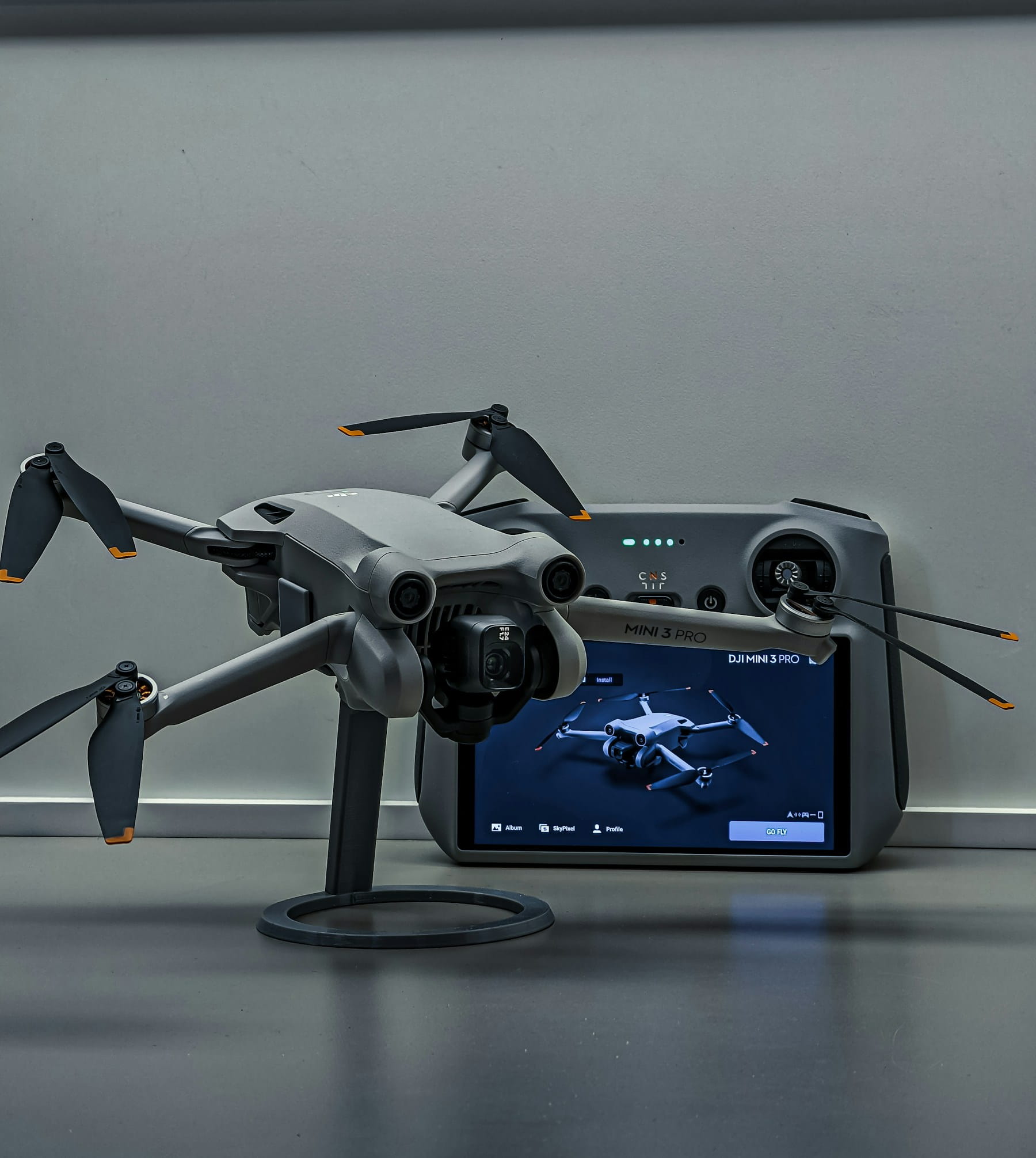
Most police drones are larger than the consumer DJI Mini series that hobbyists fly. That means their light clusters appear slightly wider and their sound carries farther. If you spot a drone that seems louder and brighter than the typical consumer quadcopter, and it is flying with purpose, police operation becomes a strong possibility. Departments running these platforms at scale rely on surveying and inspection workflows that keep every flight documented and accountable.
Rule out other objects in the night sky
Before concluding you have spotted a police drone, eliminate the common look-alikes. Misidentification is extremely common. The late-2024 New Jersey "drone scare" turned out to involve mostly conventional aircraft and satellites that residents mistook for drones.
Airplanes and helicopters. Navigation lights on aircraft are spread far apart across the wingspan or fuselage. A drone's lights cluster tightly within a few feet of each other. Helicopters produce a deep, rhythmic thudding that sounds nothing like a drone's high-pitched buzz. If you can hear rotor wash or see widely spaced lights, it is not a drone.
Satellites. These appear as steady, non-blinking points of light moving in a straight line across the sky. They never hover, change direction, or flash. Satellite passes typically last two to five minutes.
Stars and planets. Stationary points that may appear to twinkle due to atmospheric distortion. Venus in particular can look remarkably bright near the horizon and is frequently reported as a drone.
Chinese lanterns and party drones. Small hobby drones with LED light kits sometimes fly at events. Their lights tend to be multicolored in patterns of red, green, purple, or cycling rainbow sequences rather than the alternating red-blue of emergency services.
For more on distinguishing types of airspace and what you might see in each, our guide covers the classifications and their typical traffic.
RF detection apps and their limits
Some smartphone apps claim to detect drones by scanning for radio frequency activity in the 2.4 GHz and 5.8 GHz bands that drones commonly use. Apps like DroneWatcher and similar tools monitor for these signals and alert you when drone-like RF activity is nearby.
The honest assessment: these apps are unreliable for positive identification. Here is why.
The 2.4 GHz band is crowded with Wi-Fi routers, Bluetooth devices, baby monitors, and microwave ovens. Any of these can trigger false positives. The 5.8 GHz band is cleaner, but many modern drones use encrypted communication protocols that do not produce recognizable signatures for consumer scanning apps.
Professional RF detection systems used by airports and military installations cost tens of thousands of dollars and use directional antennas that consumer apps cannot replicate. A smartphone scanning omnidirectionally in a suburban environment will struggle to distinguish a drone from a neighbor's Wi-Fi extender.
Remote ID apps are far more effective. They give you verified, structured data rather than probabilistic RF guesses. Use RF scanning apps as a supplementary curiosity, not a primary detection method. For professionals managing drone security systems or no-fly zones, dedicated counter-drone hardware is a different conversation entirely.
How weather affects your ability to spot a drone
Weather conditions dramatically change your odds of detecting a drone at night, and this is something most guides completely skip.
Wind. Moderate to strong wind creates ambient noise that masks the drone's buzzing. On a calm night, you might hear a drone from 500 feet. In 15 mph winds, you probably will not hear it at all. Wind also makes the drone's lights appear to jitter slightly as it compensates for gusts, which can actually help visual identification since stars and planes do not jitter.
Cloud cover and fog. Low clouds or fog scatter the drone's strobe lights, creating a diffuse glow rather than a sharp point. This makes it easier to notice something is there but harder to identify the specific light pattern. Dense fog can hide a drone entirely. Professional operators monitor weather conditions carefully before launching, so heavy fog may actually reduce police drone activity.
Rain. Light rain does not stop most modern police drones. The DJI Matrice 30T and Skydio X10 both carry IP55 weather ratings. Heavy rain grounds most operations. If you spot a drone flying in steady rain, the operator has a weather-rated platform, which further narrows the field to professional or law enforcement use.
Temperature. Cold nights carry sound farther because cold air is denser. You are more likely to hear a drone on a 30°F winter night than a 90°F summer evening. This is simple physics, but it matters for practical detection.
Understanding how weather impacts drone operations connects directly to flight planning decisions that professional operators make daily. Teams that integrate real-time weather data into their workflow avoid launching in conditions that compromise both safety and detection range.
What to do after you spot a police drone
You have confirmed the lights, heard the buzzing, and maybe even checked Remote ID. It is a police drone. Now what?
Stay calm. In most cases, the drone is responding to a nearby incident, not specifically monitoring you. DFR programs dispatch drones to 911 calls within their coverage area. The drone overhead may be responding to a car accident, a burglary report, or a missing person search two blocks away.
Do not interfere. Shooting at, throwing objects at, or using a laser pointer against any drone violates federal law under 18 U.S.C. § 32. Interfering with a police drone can result in additional criminal charges on top of the federal offense. This applies even if you believe the drone's presence is unjustified.
Document what you observe. Note the time, location, light colors, flight pattern, and duration. If you have concerns about whether the surveillance was lawful, this documentation supports any future inquiry.
Check your local policies. Many cities publish their drone program policies online. Some jurisdictions require warrants for targeted surveillance. Others mandate public reporting of drone program activity. The EFF maintains a tracker of DFR programs and their oversight provisions, and many state ACLU chapters publish local surveillance ordinance databases.
File a public records request. If you want to know whether a specific flight targeted your area, a FOIA request (or state equivalent) to the police department can yield flight logs, dispatch records, and mission purposes. Departments with transparent compliance tracking programs will have this data readily available.
Engage in the public process. City council meetings, police commission hearings, and public comment periods are where drone program policies get shaped. Informed citizens who understand what drones can and cannot do contribute more effectively to these conversations than those speculating from misconceptions. For the operator's perspective on accountability, our overview of drone flight reports explains what professional flight documentation looks like.
Frequently asked questions
Can police drones see inside my house at night?
Police drones cannot see through walls, roofs, or closed curtains. Standard cameras require direct line of sight. Thermal cameras detect heat radiating from surfaces but cannot image what is happening inside a building. A thermal sensor might show that one room in a house is significantly warmer than others, but it cannot see people or activities through solid walls. Windows block most thermal wavelengths. Courts have generally held that thermal imaging of a home requires a warrant under the Fourth Amendment, following the Supreme Court's 2001 decision in Kyllo v. United States.
How far away can I hear a police drone at night?
In quiet residential conditions with minimal wind, a typical police drone (DJI Matrice 30T or Skydio X10) is audible from roughly 300 to 500 feet away. Larger platforms with heavier payloads can be heard from farther. Background noise from traffic, wind, or air conditioning reduces this range significantly. On a calm winter night, sound carries farther due to denser cold air, pushing audible range toward the higher end.
Are police drones legal to fly over my property at night?
Yes, in most jurisdictions. The FAA controls navigable airspace, and courts have generally held that aircraft (including drones) can fly over private property at altitudes above the immediate airspace a property owner uses. Police departments operating under Part 107 or government COAs have legal authority for nighttime flight. However, state and local laws may restrict how police use the data they collect, particularly when it comes to targeted surveillance of individuals. Regulations vary widely by state, and some localities have enacted specific drone regulations governing law enforcement use.
What is the difference between a police drone and a regular drone at night?
The most visible difference is the red and blue strobe lights that police drones carry to identify themselves as emergency vehicles. Regular drones display white anti-collision strobes plus standard red and green navigation lights. Police drones also fly in deliberate patterns (hovering, orbiting, grid searching) rather than the exploratory movements typical of hobbyists. They tend to fly longer missions, often from fixed docking stations, and they frequently carry both visible and thermal cameras rather than just a standard photo camera.
Ready to manage drone operations with full accountability?
Police drone programs are expanding fast, with over 1,500 departments now running active programs and DFR missions projected to double through 2026. Whether you run a public safety drone program or a commercial fleet, every flight needs proper documentation, compliance tracking, and real-time monitoring.
DroneBundle gives operators the tools to keep every mission logged, every pilot certified, and every flight traceable. The same accountability that citizens expect from police drone programs is what professional operators need to run a defensible operation.
Start your free trial today — no credit card required.
Or try the live demo to see flight logging and compliance tracking in action.