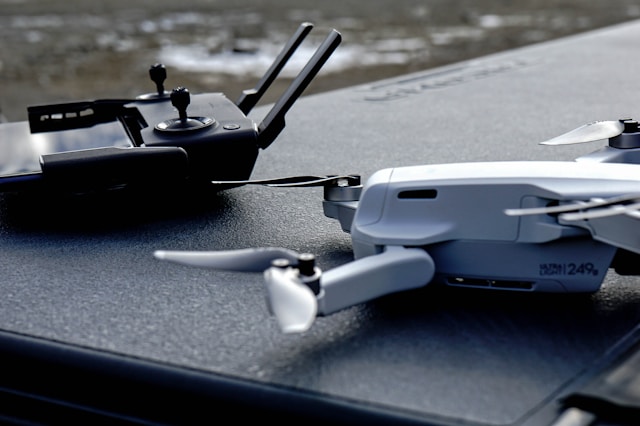
What is a Drone Security System?
A drone security system is an autonomous aerial surveillance platform that uses unmanned aerial vehicles equipped with HD and thermal cameras to patrol, monitor, and protect facilities. These systems launch from automated docking stations, fly pre-programmed routes or respond to triggered alarms, and stream real-time video to security operators, providing continuous coverage at a fraction of the cost of traditional manned security.
The drone security system market has grown from a niche concept into a $1.83 billion industry, with ResearchAndMarkets.com's Drone Airspace Security System Market Report 2026 projecting $4.58 billion by 2030. Organizations across industries are adopting autonomous drone patrols to protect large facilities, critical infrastructure, and commercial properties more effectively than traditional security guards and fixed cameras alone.
Unlike manually operated drones that require a pilot on-site, modern drone security systems operate autonomously from "drone-in-a-box" docking stations. They launch in seconds, patrol defined routes, use AI to detect and classify threats, and return to recharge without human intervention. This capability transforms how organizations approach site security operations and physical asset protection.
This guide covers how drone security systems work, leading platforms, costs and ROI, regulatory requirements, and how to evaluate the right solution for your facility.
How drone security systems work
Autonomous drone security systems follow a continuous operational loop that enables 24/7 facility protection. Understanding this cycle helps security professionals evaluate how these platforms integrate with existing infrastructure.
The autonomous patrol cycle
The process begins with a trigger: a scheduled patrol timer, an alarm from integrated ground sensors (motion, vibration, or radar), or a manual command from a security operator. Within seconds, the drone launches from its docking station and navigates to the designated area using GPS waypoints and onboard obstacle-avoidance technology.
During flight, HD and thermal imaging cameras capture live video streamed directly to the security operations center. AI algorithms detect and classify people, vehicles, and anomalies in real time, filtering out false alarms from animals or debris. Many systems include onboard speakers for audio warnings and spotlights for deterrence.
After completing the patrol or alarm verification, the drone returns to its dock, lands, and recharges automatically. This cycle enables near-continuous coverage with minimal human oversight and pairs well with drone fleet management platforms for multi-site operations.
Every patrol still needs a record: which site, which route, which client, and which aircraft flew it. For docks that run on DJI FlightHub 2, DroneBundle files each dock flight under the right client job automatically, so patrol reports build from the flight records and invoicing sits right next to them.
Integration with existing security infrastructure
Modern drone security platforms are designed to plug into established security ecosystems. Most systems integrate with video management systems (VMS) like Genetec and Milestone, access control platforms from Johnson Controls and Lenel, and ground-surveillance radar from providers like Magos. Organizations can add aerial capabilities to their existing security stack without replacing current investments.
Drone operations software enables centralized management of patrol schedules, flight logs, and incident reports across multiple sites, creating a unified security dashboard.
Types of drone security systems
The drone security landscape includes two complementary categories that address different threat vectors.
Patrol and surveillance drones
These autonomous UAVs protect facilities by flying over them on scheduled patrols or in response to alarms. Equipped with HD, thermal, and sometimes LiDAR sensors, they provide aerial surveillance coverage that fixed cameras cannot match. A single drone can cover the equivalent area of dozens of fixed CCTV cameras, eliminating blind spots across large properties.
Patrol drones transform thermal imaging from a specialized business tool into a real-time security capability, detecting intruders by body heat even in complete darkness.
Counter-drone and airspace security
The second category addresses the growing threat of unauthorized drones entering protected airspace. Counter-drone systems combine RF sensors, cameras, radar, and AI software to detect, track, and identify rogue drones. Dedrone (acquired by Axon in October 2024) leads this segment, providing solutions that protect critical infrastructure, airports, and large events from aerial threats.
A comprehensive drone security posture increasingly includes both patrol capabilities and airspace compliance measures to address threats from all vectors.
Leading drone security system platforms
Several companies have established proven track records in autonomous security drone operations.
| Platform | Key Capability | Notable Achievement |
|---|---|---|
| Sunflower Labs Beehive | AI-powered autonomous system with ground sensors | Operates at $4-7/hour; FAA approval covering 99% of U.S. |
| Nightingale Security Blackbird | All-weather patrol (rain, snow, 40 mph winds) | Over 400,000 successful autonomous missions |
| Skydio X10 / Site Security | Industry-leading obstacle avoidance AI | Supports up to 4 simultaneous drones from docks |
| Asylon Robotics Guardian | Rapid battery swap (under 3 minutes) | Over 45,000 automated patrol/alarm-response missions |
| Easy Aerial SAMS-T | Tethered drone with unlimited flight time (24+ hours) | Deployed by U.S. and allied defense forces |
| Percepto Air Max | Autonomous inspection and security drone-in-a-box | Strong presence in industrial and energy sectors |
When evaluating platforms, consider factors like flight time, weather tolerance, sensor capabilities, integration options, and operational risk profiles.
Use cases and applications
Drone security systems serve diverse industries and facility types, each with unique requirements and operational benefits.
Perimeter and facility security
Large corporate campuses, data centers, and distribution centers use autonomous drone patrols to cover fence lines and open areas that are impractical to monitor with fixed cameras alone. Public safety and emergency response organizations benefit from rapid aerial assessment of security incidents, reducing response times from minutes to seconds.
Construction site monitoring
Construction sites face equipment theft, material pilferage, and unauthorized access across large, open areas. Drone security systems provide after-hours aerial patrols combined with daytime progress monitoring. Construction and infrastructure teams use these systems alongside project management workflows to protect high-value assets.
Critical infrastructure protection
Oil fields, solar farms, power plants, and water treatment facilities require monitoring of vast areas often located in remote settings. Utilities and energy companies deploy drone security systems to check for equipment anomalies, detect unauthorized access, and ensure personnel safety across sprawling facilities where traditional security coverage is cost-prohibitive.
Commercial property security
Auto dealerships, retail centers, and warehouse complexes have seen significant results from drone security deployments. In one case reported by UAV Coach, a Kansas City auto dealership prevented the theft of a $40,000 vehicle within weeks of deploying an autonomous security drone while cutting security costs by 50%.
Cost comparison and ROI
The financial case for drone security systems becomes compelling when compared to traditional alternatives.
Traditional security costs
Round-the-clock manned security for a single post costs approximately $525,000 per year when factoring in three shifts of guards, benefits, training, and management overhead. Even a single-site 24/7 guard contract typically runs $15,000 or more per month.
Drone security system costs
Sunflower Labs reports operating costs of $4-7 per hour after initial installation, translating to roughly $35,000-$61,000 annually for continuous operation. That represents approximately one-fifth the cost of traditional manned security for equivalent coverage.
| Security Method | Approximate Annual Cost | Coverage Area | 24/7 Capable |
|---|---|---|---|
| Manned guards (24/7) | $525,000+ | Single post | Yes (3 shifts) |
| Autonomous drone patrol | $35,000-$61,000 | Entire facility | Yes (auto-recharge) |
| Fixed CCTV system | $50,000-$150,000 | Fixed angles only | Yes (passive) |
The optimal approach for most facilities is a hybrid model: drones handle wide-area patrol and rapid alarm verification, while a smaller human security team manages physical response and judgment calls. This hybrid strategy reduces staffing requirements while improving detection and response capabilities.
Proper drone insurance coverage should be factored into total cost of ownership, particularly for commercial deployments operating autonomous aircraft over or near occupied facilities.
Regulatory requirements
Operating a drone security system in the United States requires navigating FAA regulations designed for commercial drone operations. Understanding these requirements is essential for compliant deployment.
FAA Part 107 compliance
All commercial drone operations currently fall under 14 CFR Part 107, which establishes baseline rules: visual line of sight, 400-foot altitude ceiling, daylight operations, and restrictions on flights over people. Security drone operators must hold a valid FAA remote pilot certificate.
Since most autonomous security patrols require beyond visual line of sight (BVLOS) operations, companies currently obtain Part 107 waivers from the FAA. Several security drone providers have secured nationwide BVLOS waivers for operations on business properties.
Part 108 BVLOS framework
The FAA published a proposed rule for Part 108 in August 2025. It would create a dedicated regulatory framework for BVLOS operations. Executive Order 14307 asked for a final rule within 240 days, by February 1, 2026, and that date passed. No final rule has been published. The draft final rule has been under White House (OIRA) review since July 10, 2026, and no official source gives a publication or effective date.
Under the Part 108 proposal, BVLOS operations would require an operating permit (valid for 24 months) or an operating certificate. If finalized, the rule could speed up drone security system adoption by replacing the current waiver-by-waiver approval process with a standardized framework. Until then, BVLOS flights still need a Part 107 waiver, a Section 44807 exemption, or a Section 927 waiver.
Remote ID requirements
All drones must broadcast Remote ID signals (effective since March 2024), allowing authorities to identify and locate drones in flight. This requirement applies to security patrol drones and is a prerequisite for the broader BVLOS framework.
Organizations deploying drone security systems should develop comprehensive flight planning protocols and risk assessment procedures to maintain regulatory compliance.
Choosing the right drone security system
Selecting the appropriate platform depends on several facility-specific factors.
Assessment criteria
Facility size and layout: Larger properties with complex perimeters benefit from systems with longer flight times and multi-drone capability. Properties with overhead obstructions may require advanced obstacle avoidance.
Environmental conditions: Facilities in regions with harsh weather need platforms rated for rain, snow, and high winds. Nightingale Security's Blackbird, for example, operates in winds up to 40 mph.
Integration requirements: Evaluate compatibility with your existing VMS, access control, and alarm systems. Platforms that integrate with standard security protocols and drone management features reduce implementation complexity.
Sensor requirements: Standard HD cameras suffice for daylight operations, but most security applications require thermal imaging for nighttime detection. Consider whether you need additional sensors for inspection capabilities.
Regulatory readiness: Verify that the vendor holds appropriate FAA waivers for BVLOS operations in your deployment area. Review their compliance track record and their preparedness for the proposed Part 108 requirements.
Frequently asked questions
Can a drone security system operate 24/7?
Yes. Autonomous drone-in-a-box systems operate continuously by automatically returning to their docking station to recharge between patrols. Tethered systems like Easy Aerial's SAMS-T can fly for 24+ hours continuously via a power-over-cable connection. Most facilities achieve effective 24/7 coverage with automated patrol scheduling and alarm-triggered response flights.
Do you need an FAA license to operate a drone security system?
Commercial drone security operations require a Part 107 remote pilot certificate at minimum. Autonomous BVLOS operations currently require additional FAA waivers. The proposed Part 108 rule would create a more accessible framework for BVLOS security operations if it is finalized. Organizations should also maintain proper pilot certifications and insurance coverage for commercial deployments.
How do drone security systems compare to traditional CCTV?
Fixed CCTV cameras provide continuous monitoring of specific areas but cannot reposition or cover blind spots. Drone security systems provide dynamic, on-demand aerial coverage across an entire facility. The most effective approach combines both: CCTV for continuous fixed-point monitoring and drones for patrol, alarm verification, and rapid response to incidents.
What happens if a security drone detects an intruder?
When AI-powered detection identifies a potential threat, the system alerts the security operations center with live video and classified threat data. The drone can activate deterrent measures including spotlights, sirens, and audio warnings. Simultaneously, the security team receives actionable intelligence for coordinating a physical response.
Implementation considerations
Deploying a drone security system requires careful planning across technical, regulatory, and operational dimensions. Start by conducting a thorough site assessment to identify patrol routes, docking station placement, potential obstacles, and RF interference sources. Most vendors offer site surveys as part of the implementation process.
Regulatory compliance should be addressed early. Work with your chosen vendor to confirm their FAA waiver coverage applies to your location, or begin the waiver application process well in advance. Budget for both the initial hardware investment and ongoing operational costs including maintenance, software subscriptions, and fleet management overhead.
Training your security team on the new platform is essential for effective adoption. While the drones operate autonomously, operators need to understand how to interpret AI-generated alerts, manage patrol schedules, and coordinate drone-based intelligence with physical response procedures.
In summary
Drone security systems represent a fundamental shift in how organizations protect physical assets and facilities. The combination of autonomous flight, AI-powered threat detection, and thermal imaging delivers coverage capabilities that traditional manned security and fixed cameras cannot match, at a significantly lower cost.
The drone airspace security market is projected to grow from $1.83 billion in 2025 to $4.58 billion by 2030, driven by improving technology, decreasing costs, and the FAA's proposed Part 108 BVLOS framework. Organizations that evaluate and adopt these systems now position themselves ahead of the adoption curve while gaining immediate security and cost benefits.
Whether protecting a single commercial property or managing security across multiple sites, drone security systems provide the scalable, intelligent aerial surveillance that modern security demands.
Ready to manage your drone security operations?
Drone security operations require robust fleet management, compliance tracking, and operational oversight across multiple sites and aircraft. DroneBundle provides the complete operational platform for managing autonomous drone fleets, from flight logging and maintenance scheduling to compliance documentation and post-flight review.
Start your free trial today - no credit card required.
Or book a demo to see how DroneBundle streamlines drone security operations with synced flight logs and comprehensive operations management.