
What is Drone Pilot Certification Management?
Drone pilot certification management tracks individual pilot credentials, training completion, certification expiration dates, and competency requirements across commercial operations teams. Systematic management ensures qualified pilots operate aircraft appropriately while maintaining regulatory compliance through automated alerts, documentation systems, and audit-ready records.
Why certification management matters
Single-pilot operations make credential tracking straightforward. One person maintains their own certificate, completes recurrent training on schedule, and tracks personal qualifications. Scaling beyond individual operations introduces complexity that manual tracking cannot handle effectively.
The compliance burden multiplies with team size. Three pilots require tracking three certification expiration dates, six recurrent training deadlines, and potentially dozens of aircraft-specific endorsements. Ten pilots create exponentially more coordination complexity. Fifty pilots make manual tracking practically impossible.
Regulatory violations carry serious consequences. Operating with expired certifications can result in civil penalties exceeding $1,000 per violation. Insurance claims may be denied if pilots lack current credentials. Client contracts often include audit rights requiring proof of pilot qualifications.
Operational disruption from certification lapses damages client relationships and revenue. A pilot grounded mid-project due to expired recurrent training forces expensive schedule changes. Last-minute discovery of qualification gaps prevents mission execution during critical windows.
Financial impact extends beyond direct penalties. Lost revenue from cancelled missions, rush fees for expedited training, and premium pricing for backup pilots compound certification management failures. Professional reputation damage proves difficult to quantify but significantly affects long-term business viability.
Systematic certification management transforms reactive scrambles into predictable operational workflows. Automated alerts provide advance warning before credentials expire. Centralized tracking enables managers to verify qualifications instantly. Audit-ready documentation demonstrates compliance without emergency preparation.
Part 107 certification requirements
The FAA Part 107 remote pilot certificate establishes baseline requirements for commercial drone operations. Initial certification requires passing an aeronautical knowledge test covering regulations, airspace, weather, loading, emergency procedures, and crew resource management.
Certificate validity lasts 24 calendar months from the month of issuance or renewal. This differs from traditional calendar-based expirations creating tracking complexity. A certificate issued in March 2024 expires at the end of March 2026, not on the specific day two years later.
Physical certificate cards display expiration information but require manual tracking. Wallet cards get lost, damaged, or forgotten during field operations. Relying on physical cards for verification creates operational risk and administrative burden.
Online verification through the FAA Airmen Certification Database provides official confirmation of pilot credentials. However, this requires manual lookups and doesn't provide automatic alerts for approaching expirations. Fleet operators need proactive notification systems rather than reactive verification.
Additional endorsements modify certificate authority for specific operations. Night operations, operations over people, and operations from moving vehicles each require documented training completion. These endorsements lack separate expiration tracking in FAA systems despite training requirements.
Certificate suspension or revocation removes operational authority regardless of expiration dates. Medical conditions, enforcement actions, or legal judgments can invalidate certificates immediately. Managers must monitor certificate status beyond simple expiration tracking.
Recurrent training compliance
FAA recurrent training requirements mandate completion every 24 calendar months to maintain certification currency. This replaced previous requirements for in-person testing, reducing administrative burden while maintaining competency standards.
Two online training courses serve different pilot populations. ALC-515 targets pilots holding both Part 107 and Part 61 certificates. ALC-677 serves pilots with only Part 107 certification. Completing the wrong course fails to satisfy recurrent training requirements despite time investment.
Training completion resets the 24-month clock from the month of completion. A pilot completing training in January 2024 must complete the next recurrent training by January 31, 2026. Completing training early (in December 2025) resets the clock to December 2027, potentially losing a month of currency.
Night operations require specific training elements introduced in 2021. Pilots certified before April 6, 2021 must complete updated recurrent training to maintain night operation authority. Some pilots hold certificates but lack authorization for after-dark missions without realizing the restriction.
Training documentation requires retention for audit purposes. Completion certificates from the FAA Safety Team website provide official records. However, these exist as individual PDF downloads rather than integrated management systems. Operators managing multiple pilots face significant administrative burden collecting and organizing documentation.
Tracking complications arise from pilots completing training on personal initiative without notifying operations managers. Well-intentioned early completion creates confusion when managers schedule training based on outdated expiration dates. Centralized tracking systems prevent this coordination failure.
The following table compares recurrent training requirements:
| Pilot Type | Course Code | Frequency | Special Requirements |
|---|---|---|---|
| Part 107 only | ALC-677 | 24 months | Standard recurrent training |
| Part 107 + Part 61 | ALC-515 | 24 months | Requires Part 61 currency |
| Night operations | Either course | 24 months | Must include night content |
| Pre-2021 certificate | Updated course | 24 months | Required for night ops authorization |
Tracking multiple pilot credentials
Fleet operations require visibility into team-wide qualification status. Operations managers need instant answers to questions like "who can fly this aircraft type?" or "which pilots need recurrent training this month?" Manual systems provide neither speed nor accuracy.
Individual pilot profiles consolidate all credential information in accessible formats. Certificate numbers, expiration dates, training completion records, and aircraft-specific endorsements create comprehensive qualification pictures. Missing any element creates incomplete tracking that enables compliance failures.
Aircraft type qualifications vary significantly across drone platforms. DJI experience doesn't translate to fixed-wing operations. Mapping drones require different skills than inspection platforms. Managers must match pilot qualifications to specific mission requirements accurately.
Multiple certificate holders complicate family or partnership operations. Different pilots may hold the certificate while others operate under their authority. Tracking who holds credentials versus who performs operations requires careful documentation.
International operations introduce additional credentialing requirements. EASA regulations in Europe, UK CAA requirements, Transport Canada standards, and other national systems create parallel tracking obligations. Pilots operating across borders need multiple credentials with independent expiration schedules.
Competency assessment beyond basic certification helps match pilots to appropriate missions. Some pilots excel at technical inspections while others perform better with creative photography. Experience levels vary with specific aircraft or operational environments. These qualifications lack formal credentials but significantly affect operational success.
Endorsement tracking complicates credential management. Operations over people, BVLOS waivers, night operations, and specialized approvals all modify baseline certificate authority. Each endorsement may have independent training or authorization requirements requiring separate tracking.
Competency and endorsement management
Certificate possession proves minimum regulatory compliance but doesn't guarantee operational competency. Professional training programs develop skills beyond basic certification testing. Operations managers must track both regulatory credentials and practical capabilities for successful business operations.
Type ratings establish pilot qualification for specific aircraft models. Manufacturer training programs provide formal education but lack standardized documentation. Internal checkout procedures fill gaps but require systematic tracking. Without clear records, managers cannot confidently assign pilots to appropriate aircraft.
Mission-specific competencies require specialized training and experience. Precision inspection work demands different skills than agricultural applications. Emergency response operations need capabilities beyond typical commercial missions. These competency categories lack formal FAA recognition but critically affect operational capability.
Internal competency tracking creates custom qualification systems matching organizational needs. Check rides, supervised missions, and proficiency evaluations document pilot capabilities. However, these internal systems require consistent application and comprehensive documentation.
Proficiency currency differs from certification currency. Pilots may hold current certificates but lack recent flight experience. Operations managers should track last flight date through flight hour tracking systems, total experience hours, and recent mission types. These factors affect assignment decisions even with valid certification.
The competency framework typically includes these elements:
- Regulatory credentials (Part 107 certificate with current recurrent training)
- Aircraft qualifications (manufacturer training, internal checkout completion)
- Mission competencies (inspection, mapping, photography, emergency response)
- Environmental experience (urban operations, marine environments, challenging weather)
- Special endorsements (night operations, BVLOS authority, operations over people)
- Client-specific requirements (security clearances, industry certifications)
Equipment-specific training ensures pilots understand aircraft capabilities and limitations. Autopilot systems, obstacle avoidance, and emergency procedures vary between platforms. Managers must verify pilots received training on specific equipment they will operate.
Automated expiration tracking
Manual calendar systems fail under the complexity of multi-pilot operations. Spreadsheet tracking requires constant updates and provides no automatic alerts. Email reminders get buried in busy inboxes. Paper calendars offer no advance warnings.
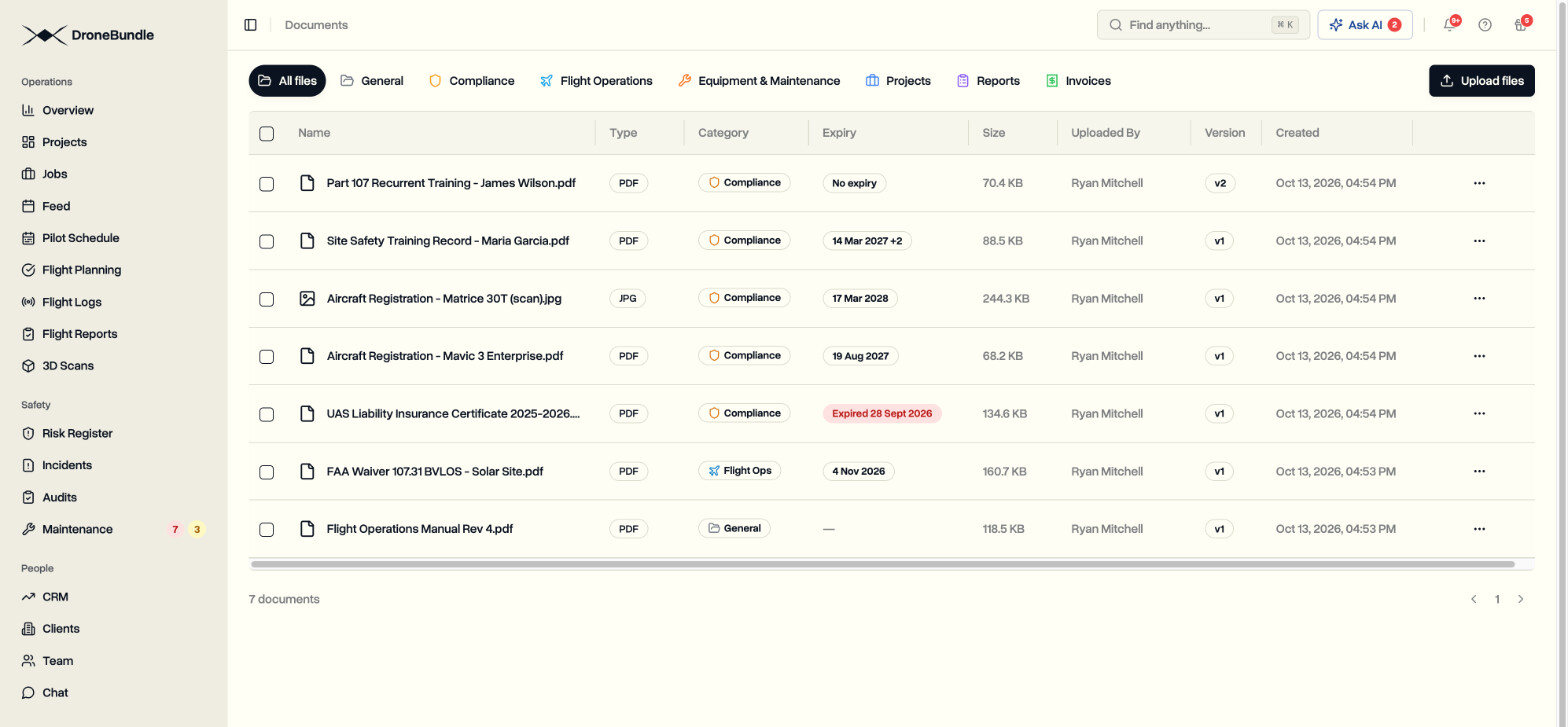
Automated tracking systems monitor all credential expiration dates continuously. Modern drone operations software generates alerts at configurable intervals before credentials expire. 90-day, 60-day, and 30-day warnings provide escalating urgency as deadlines approach. DroneBundle takes the dates from the paperwork itself: upload a certificate and the expiry date is read from the document, with reminders 30 days before, 7 days before, and on the day.
Alert distribution should reach multiple organizational levels. Pilots receive personal notifications about their own credentials. Operations managers get team-wide visibility. Senior leadership monitors compliance trends and systematic issues.
Integration with scheduling systems prevents assignment of pilots with insufficient credential currency. Mission planning software can block assignments for pilots approaching expiration or lacking required endorsements. This proactive prevention stops compliance violations before they occur.
Dashboard visualization provides instant compliance status across entire teams. Color-coded displays highlight pilots with expired credentials, approaching expirations, or current qualifications. Management can assess team readiness at a glance rather than manual review.
Batch processing capabilities streamline training coordination. Systems can identify all pilots requiring recurrent training in upcoming months. Operations managers schedule group training sessions rather than individual arrangements. This reduces administrative overhead while ensuring consistent training delivery.
Documentation automation generates required records without manual effort. Systems can produce pilot qualification summaries, certification status reports, and audit documentation automatically. This eliminates time-consuming manual compilation while ensuring accuracy.
Audit preparation and documentation
Regulatory audits and client reviews require comprehensive credential documentation on short notice. Organizations lacking systematic record keeping face expensive scrambles assembling required information. Preparation should be continuous process rather than reactive response.
Complete pilot files include certificates, training completion records, endorsement documentation, and proficiency assessments. Digital systems consolidate these documents in searchable repositories. Physical files scatter across offices and vehicles creating recovery challenges during audits.
Audit timelines rarely provide adequate preparation windows. Client requests might allow days or weeks. Regulatory inspections can occur with minimal advance notice. Only maintained current documentation enables confident audit responses.
Documentation standards exceed minimum regulatory requirements for professional operations. Comprehensive records demonstrate systematic safety culture and professional management. This documentation often influences audit outcomes and operational approvals.
Record retention requirements vary by jurisdiction and operation type. Federal regulations specify minimum retention periods for specific documents. State laws may impose additional requirements. International operations add further complexity. Documentation systems should maintain records beyond minimum periods for safety and liability protection.
Third-party verification often requires certification validation. Insurance providers, clients, and regulatory authorities may independently verify pilot credentials. Systems should enable quick production of verification letters or digital access to credential documentation.
The audit-ready documentation set includes:
- Current certificates for all pilots with expiration dates visible
- Recurrent training completion certificates with course numbers and dates
- Initial knowledge test results showing pass dates and scores
- Endorsement documentation for night operations, BVLOS, and special authorities
- Proficiency records demonstrating ongoing competency maintenance
- Training attendance logs for internal or manufacturer programs
Digital signatures and timestamps provide authentication for electronic records. Cloud storage ensures availability regardless of physical location. Version control prevents document confusion when certificates renew or qualifications update.
Frequently asked questions
What happens if a pilot's certificate expires during a project?
Operating with expired certification violates FAA regulations and exposes operations to civil penalties. The pilot must immediately cease commercial operations until completing recurrent training and restoring certificate currency. Project work must pause, reschedule with qualified pilots, or potentially cancel depending on contractual obligations. This highlights why proactive expiration tracking prevents operational disruptions rather than reacting to expired credentials.
Can we verify pilot certifications ourselves?
The FAA Airmen Certification Database provides public access to pilot credential verification. Search requires the pilot's name, certificate number, or birthdate. However, this only confirms certificate existence and validity, not recurrent training currency or specific endorsements. Comprehensive verification requires pilots to provide training completion certificates from the FAA Safety Team website.
How do we handle pilots from different states or countries?
US operations require FAA Part 107 certificates regardless of pilot residence. International pilots operating in US airspace must obtain Part 107 certification through the same process as American pilots. Conversely, US pilots working internationally need credentials recognized in those jurisdictions. Many countries require local licensing or foreign pilot authorization. Track all applicable credentials separately with their independent expiration schedules.
What if pilots complete training early?
Early training completion resets the 24-month clock from the completion month, not the original expiration. This can slightly shorten overall currency if completed too far in advance. However, operational needs often justify early completion. Update tracking systems immediately when pilots complete training independently to prevent scheduling conflicts or duplicate training assignments.
Implementation considerations
Selecting certification management approaches depends on operation size, growth trajectory, and existing systems. Small teams might manage with enhanced spreadsheets and calendar systems. Growing operations benefit from dedicated fleet management software. Large enterprises require enterprise-grade solutions with full integration capabilities.
Software evaluation criteria should include ease of use, alert capabilities, documentation storage, reporting functionality, and integration options. Systems requiring extensive training or generating steep learning curves face adoption resistance. User-friendly interfaces improve compliance through consistent utilization.
Data migration from existing tracking systems requires careful planning. Historical training records, certificate information, and endorsement documentation must transfer accurately. Incomplete migration creates gaps in qualification tracking that undermine system benefits.
Pilot onboarding processes must include credential collection and verification. New team members should provide all certificates, training completion records, and endorsement documentation. Verification through FAA databases confirms information accuracy. Incomplete onboarding creates compliance risks from day one.
Regular audits of tracking system accuracy ensure data currency. Quarterly reviews comparing system records against pilot-provided documentation identify discrepancies. These audits become increasingly important as operations scale and pilot counts grow.
Change management addresses organizational adoption challenges. Pilots accustomed to managing personal credentials may resist centralized tracking. Clear communication about benefits and requirements improves acceptance. Emphasizing how systems protect pilots from inadvertent violations builds support.
Backup procedures ensure continued operations during system failures. Cloud-based solutions provide inherent redundancy. On-premise systems need robust backup and recovery procedures. Manual contingency processes enable operations during extended outages.
In summary
Pilot certification management transforms from simple personal tracking to complex organizational systems as operations scale. Manual approaches that work for individual pilots fail under the coordination demands of multi-pilot operations. Systematic management prevents regulatory violations, operational disruptions, and compliance failures.
Automated tracking systems provide the only viable approach for operations beyond a few pilots. Continuous monitoring, proactive alerts, and centralized documentation create audit-ready compliance frameworks. These systems protect operations from expensive violations while streamlining administrative burden.
Investment in proper certification management delivers returns through avoided penalties, prevented operational disruptions, and maintained professional reputation. The cost of systematic tracking pales compared to a single regulatory violation or cancelled project. Smart operators prioritize compliance infrastructure early rather than reacting to failures.
Technology continues improving certification management capabilities. Integration with scheduling systems, automated FAA database verification, and predictive analytics represent emerging capabilities. Early adopters of comprehensive systems establish competitive advantages through reliable operations and demonstrated professionalism.
Ready to Simplify Pilot Certification Management?
DroneBundle reads the expiry date from every certificate, license, and training record you upload and reminds you before it lapses. The paperwork for your whole team sits in one place, next to the flight hours each pilot has logged.
Stop relying on spreadsheets and manual calendar reminders. Professional drone operations demand professional compliance management. Track certifications, endorsements, and competencies effortlessly across your entire pilot team.
Start your free trial today - no credit card required.
Or book a demo to see how DroneBundle integrates pilot certification management with comprehensive compliance tracking and operational planning.