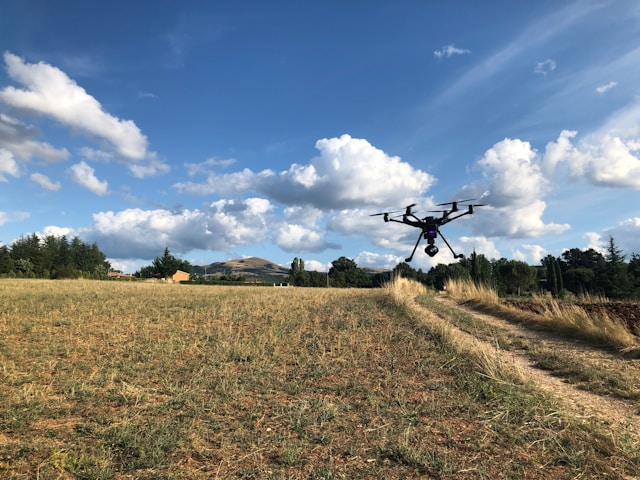
What is the Largest Drone?
The largest drone in the world is the Northrop Grumman RQ-4 Global Hawk, a military surveillance UAV with a 131-foot wingspan (larger than a Boeing 737), weighing over 32,000 pounds. For commercial applications, the largest drone by payload capacity is the Griff Aviation 300, capable of lifting 500 pounds (227 kg), with heavy-lift cargo drones reaching payloads exceeding 1,000 pounds for industrial and logistics operations.
The largest drone models serve vastly different purposes than the consumer quadcopters most pilots fly. Heavy lift drones transport cargo, spray agricultural fields, carry cinema equipment, and perform industrial tasks that smaller aircraft cannot handle. Understanding what qualifies as a big drone and which models lead each category helps operators select appropriate equipment for demanding applications.
The FAA classifies drones differently based on weight and operational requirements. While Part 107 covers small unmanned aircraft under 55 pounds, larger drones often require special certifications, waivers, and operational protocols that reflect their increased capabilities and risks.
What defines a large drone
Size classifications for drones depend on context. A drone considered large in consumer markets might be small compared to industrial cargo UAVs. Several metrics help categorize big drones:
Classification by weight
| Category | Weight Range | Typical Use |
|---|---|---|
| Small UAS | Under 55 lbs (25 kg) | Consumer, Part 107 commercial |
| Medium UAS | 55-300 lbs | Enterprise, specialized commercial |
| Large UAS | Over 300 lbs | Cargo, military, industrial |
The 55-pound threshold matters because it defines the upper limit for standard Part 107 certification. Heavier drones require additional certifications, specific airworthiness approvals, or operation under experimental categories.
Classification by payload capacity
Payload capacity often matters more than total weight for commercial operators. Heavy lift drones range from 10 kg payload platforms suitable for surveying equipment to 200+ kg cargo drones capable of transporting building materials.
Classification by wingspan
Fixed-wing drones measure size by wingspan rather than weight. Wingspan affects flight characteristics, range, and the operational space needed for takeoff and landing. Military reconnaissance drones exceed 100-foot wingspans, while commercial fixed-wing cargo drones typically span 10-20 feet.
Largest drones in the world
The absolute largest drones operate in military and experimental contexts, though commercial platforms continue growing in size and capability.
Military reconnaissance drones
The Northrop Grumman RQ-4 Global Hawk holds the record as the largest operational drone:
- Wingspan: 131 feet (40 meters)
- Length: 48 feet (14.5 meters)
- Weight: 32,000+ pounds (14,500 kg)
- Altitude: 60,000+ feet
- Endurance: 30+ hours
- Purpose: High-altitude surveillance and reconnaissance
For context, the Global Hawk's wingspan exceeds that of a Boeing 737. It represents the extreme end of unmanned aircraft capabilities, operating at altitudes and durations impossible for manned reconnaissance aircraft.
Experimental and prototype drones
Several companies develop even larger drones for cargo and passenger transport:
- Rhaegal Kelekona: Designed for 40-passenger capacity
- Boeing MQ-25 Stingray: Carrier-based refueling drone
- Various air taxi prototypes: Targeting urban mobility markets
These platforms push boundaries of what unmanned aircraft can accomplish, though most remain in development or limited deployment.
Heavy lift drones by payload capacity
According to Pilot Institute's analysis, commercial heavy lift drones now reach payload capacities previously impossible for unmanned aircraft.
Top heavy lift drones
| Drone | Payload Capacity | Price | Key Features |
|---|---|---|---|
| Griff Aviation 300 | 500 lbs (227 kg) | $250,000+ | Industrial lifting, modular design |
| EH216-S | 485 lbs (220 kg) | N/A | Passenger-capable eVTOL |
| Rotor Technologies Airtruck | 1,000+ lbs | $850,000 | Utility helicopter conversion |
| Dronamics Black Swan | 770 lbs (350 kg) | N/A | Fixed-wing, 2,500 km range |
| JOUAV CW-80E | 110 lbs (50 kg) | Contact | 8-hour endurance, hybrid VTOL |
Griff Aviation series
Griff Aviation leads the heavy lift market with their Guardian and 300 series platforms. The Griff 300 lifts 500 pounds and the company plans versions capable of 800 kg (1,760 lbs) payload. These drones serve construction and infrastructure applications where transporting materials by air saves time and enables access to difficult locations.
Rotor Technologies platforms
Rotor Technologies converts traditional helicopter airframes into autonomous platforms. Their Airtruck handles 1,000+ pound payloads for utility operations, while the Sprayhawk carries 110-gallon spray tanks for agricultural applications. These represent the largest commercially available drones in terms of raw lifting capacity.
Cargo and delivery drones
Cargo drones bridge the gap between package delivery and heavy industrial transport. These platforms enable BVLOS operations that transform logistics in remote areas.
DJI FlyCart series
DJI entered the cargo drone market with purpose-built delivery platforms:
DJI FlyCart 30
- Payload: 30 kg (66 lbs) with dual batteries
- Range: 28 km without payload, 16 km fully loaded
- Flight time: 18 minutes with payload
- Features: Dual delivery modes (winch and airdrop)
DJI FlyCart 100
- Payload: Up to 80 kg
- Charging: 9-minute fast charging
- Application: Medium-distance cargo transport
These platforms target logistics companies, emergency services, and island/mountain supply chains where ground transport is impractical.
Fixed-wing cargo drones
Fixed-wing designs offer superior range and efficiency for cargo operations:
Dronamics Black Swan
- Payload: 350 kg (770 lbs)
- Range: 2,500 km
- Design: Fixed-wing for efficient long-distance flight
- Status: UAE production facility opening 2025
Fixed-wing cargo drones suit hub-to-hub logistics rather than last-mile delivery, complementing multirotor platforms in comprehensive logistics networks.
Hybrid VTOL cargo platforms
Hybrid designs combine vertical takeoff with efficient forward flight:
JOUAV CW-80E
- Payload: 50 kg (110 lbs)
- Endurance: Up to 8 hours
- Range: 300+ miles
- Speed: 135 km/h cruise
Hybrid VTOL platforms excel at medium-range cargo missions requiring precise delivery without runway infrastructure.
Enterprise inspection platforms
Enterprise drones for power line inspections, infrastructure surveys, and industrial applications balance payload capacity against flight time and sensor integration.
DJI Matrice series
The DJI Matrice 350 RTK represents DJI's flagship enterprise platform:
| Specification | Value |
|---|---|
| Max Takeoff Weight | 9.2 kg |
| Max Payload | 2.7 kg |
| Flight Time | 55 minutes |
| Transmission Range | 20 km |
| IP Rating | IP55 |
| Operating Temp | -20° to 50°C |
The Matrice 350 RTK supports multiple thermal and visual camera payloads including the Zenmuse H30T for comprehensive inspection software workflows. RTK positioning delivers centimeter-level accuracy for surveying applications.
DJI Matrice 30T A more compact option with integrated thermal camera, 41-minute flight time, and IP55 protection. The folding design improves portability for field teams conducting utilities and energy inspections.
DJI Matrice 4T (2025) The newest addition combines Mavic-style portability with enterprise capabilities, including integrated thermal imaging and AI-powered detection features for public safety applications.
Alternative enterprise platforms
Beyond DJI, several manufacturers offer enterprise-grade big drones:
- Autel EVO Max 4T: Four-camera system with SLAM navigation
- Freefly Astro: Modular platform for mapping and inspection
- Skydio X10: American-made with autonomous capabilities
The best drones 2026 guide covers consumer and prosumer options, while enterprise platforms require evaluation based on specific operational requirements.
Agricultural heavy lift drones
Agricultural drones represent one of the largest commercial drone markets, with heavy lift platforms spraying hundreds of acres daily.
DJI Agras series
DJI Agras T50
- Spray tank: 40 liters (10.5 gallons)
- Payload: 50 kg including tank and liquid
- Spread width: 9-11 meters
- Coverage: 60+ acres per hour
The Agras T50 handles precision spraying for crop protection, fertilization, and seeding applications. Integrated terrain following and obstacle avoidance enable safe operation over varied agricultural terrain.
XAG agricultural drones
XAG V40
- Payload: 25 kg
- Design: Unique dual-rotor configuration
- Features: AI-powered crop analysis
- Dimensions: 1790 mm length
XAG's dual-rotor design differs from traditional multirotor configurations, offering distinct airflow patterns for spray distribution.
Industrial agricultural platforms
The Rotor Technologies Sprayhawk represents the extreme end of agricultural drones:
- Capacity: 110 gallons
- Price: $990,000
- Platform: Converted helicopter airframe
- Application: Large-scale agricultural operations
These platforms compete with manned agricultural aircraft for efficiency while offering autonomous operation benefits.
Cinema and industrial applications
Cinema production and industrial operations require drones capable of carrying heavy professional equipment while maintaining stable flight.
Freefly Alta X
The Freefly Alta X dominates cinema heavy lift applications:
- Payload: 35 lbs (15.9 kg)
- Configuration: Top or bottom mounting
- Flight time: 13-50 minutes depending on payload
- Applications: Cinema cameras, LiDAR systems, specialized sensors
The Alta X's modular design accommodates various mounting configurations, supporting cinema cameras like RED and ARRI systems that exceed typical drone payload limits.
Industrial inspection platforms
Beyond standard enterprise drones, industrial applications sometimes require custom heavy lift solutions:
- Confined space inspection: Specialized drones for tank and vessel interior surveys
- Radiation monitoring: Shielded platforms for nuclear facility inspections
- Maritime operations: Salt-resistant platforms for offshore inspections
These specialized platforms often start with heavy lift frames customized for specific operational requirements.
Regulations for large drones
Operating large drones involves regulatory requirements beyond standard Part 107 certification.
Weight-based requirements
14 CFR Part 107 only covers drones under 55 pounds. Heavier drones need FAA approval outside Part 107, such as a Section 44807 exemption, which can involve:
- Special airworthiness certificates
- Type certification for certain operations
- Additional pilot qualifications
- Enhanced operational limitations
The FAA continues developing frameworks for larger drone operations as the industry matures.
Operational considerations
Large drone operations typically require:
- Extended visual observer networks or BVLOS waivers
- Enhanced flight planning and risk assessment
- Comprehensive insurance coverage
- Remote ID compliance and tracking
- Detailed compliance documentation
Organizations deploying heavy lift drones should invest in equipment management systems capable of tracking maintenance, certifications, and operational requirements.
Emerging regulations
The drone regulations news landscape continues evolving for large UAS operations. The proposed Part 108 BVLOS rule would cover aircraft up to 1,320 pounds, including payload, if it is finalized. No final rule has been published yet. Together with expanded type certification pathways, it could enable broader heavy lift drone deployment as regulatory frameworks mature.
Frequently asked questions
What is the biggest drone you can buy?
The largest commercially available drones include the Griff Aviation 300 with 500-pound payload capacity for approximately $250,000, and the Rotor Technologies Airtruck with 1,000+ pound capacity for $850,000. For more accessible heavy lift options, the DJI FlyCart 30 offers 66-pound payload for cargo delivery applications. Enterprise inspection platforms like the DJI Matrice 350 RTK represent the largest drones most commercial operators actually deploy.
Do you need a special license for large drones?
Drones under 55 pounds operate under standard Part 107 certification. Heavier drones require additional FAA authorization, which may include special airworthiness certificates, experimental aircraft permits, or type certification depending on the specific aircraft and intended operations. Contact the FAA or a designated pilot examiner for requirements specific to your planned operations.
How much can the largest commercial drone carry?
The Rotor Technologies Airtruck leads commercial payload capacity at over 1,000 pounds, though it requires specialized operation protocols. The Griff Aviation 300 carries 500 pounds in a more accessible heavy lift multirotor format. DJI's FlyCart 100 handles 80 kg (176 lbs) for cargo delivery applications. Agricultural drones like the Agras T50 carry 50 kg including spray tanks and liquid.
Are heavy lift drones worth the investment?
Heavy lift drones justify investment when operational requirements exceed smaller platform capabilities. Construction companies transporting materials to difficult sites, agricultural operations covering hundreds of acres, and logistics companies serving remote areas find heavy lift drones transform operational economics. Evaluate total cost including the aircraft, training, insurance, maintenance, and regulatory compliance against operational benefits for your specific use case.
Implementation considerations
Deploying large drones requires infrastructure beyond the aircraft itself. Ground support equipment, trained personnel, maintenance facilities, and operational procedures all scale with platform size.
Consider starting with proven enterprise platforms before investing in specialized heavy lift equipment. The DJI Matrice series and similar enterprise drones handle most commercial inspection and survey applications while building operational experience applicable to larger platforms.
Organizations considering heavy lift cargo or agricultural drones should evaluate total operational costs including regulatory compliance, specialized training, and support infrastructure. Starting a drone business with heavy lift capabilities requires significant upfront investment but can access markets smaller operators cannot serve.
Develop relationships with manufacturers and service providers before purchasing large platforms. Support availability, parts supply chains, and specialized maintenance requirements differ significantly from consumer drone ecosystems.
In summary
The largest drone category spans military reconnaissance platforms with 130-foot wingspans to commercial heavy lift drones carrying 1,000+ pounds. Understanding the distinctions between military, cargo, enterprise, agricultural, and industrial platforms helps operators identify equipment appropriate for their specific applications.
Heavy lift capabilities continue expanding as battery technology, airframe design, and regulatory frameworks mature. What required manned aircraft or ground transport a decade ago now falls within drone capabilities, transforming industries from construction to agriculture to emergency response.
For most commercial operators, enterprise platforms like the DJI Matrice series represent the practical upper limit of drone size. These platforms balance payload capacity, flight time, and regulatory simplicity while supporting the thermal, visual, and LiDAR sensors professional operations require.
Ready to manage your drone fleet?
Professional drone operations require systematic approaches to equipment tracking, maintenance scheduling, and compliance documentation. Whether you operate compact consumer drones or enterprise heavy lift platforms, organized workflows ensure regulatory compliance and operational efficiency.
Start your free trial today - no credit card required.
Or book a demo to see how DroneBundle helps operators manage equipment across their fleet and maintain comprehensive operational documentation.