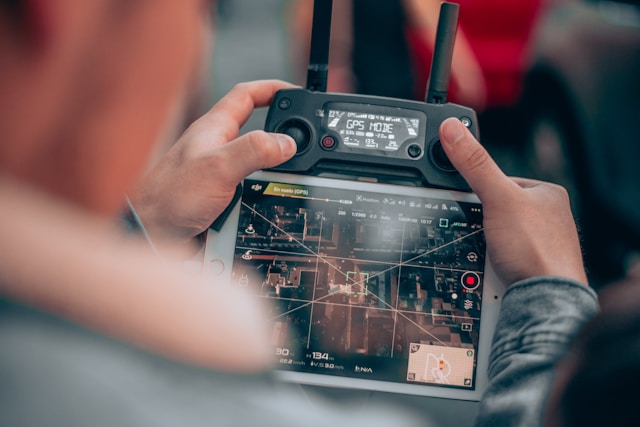
How Do You Become a Drone Pilot?
To become a commercial drone pilot in the United States, you need to pass the FAA Part 107 Knowledge Test ($175), register your drone with the FAA ($5), comply with Remote ID requirements, and obtain drone insurance. The entire process takes 4-12 weeks and costs $1,000-$3,500 to get started, including equipment. No college degree is required, and the exam has an 84.2% pass rate.
Learning how to become a drone pilot opens the door to a rapidly growing industry with over 2.1 million people employed worldwide. The commercial drone market is expanding at a 12-14% annual growth rate, creating more than 100,000 new jobs in the United States alone across specializations ranging from infrastructure inspection to aerial mapping.
The path to becoming a certified drone pilot is more accessible than most people expect. Unlike manned aircraft licenses that cost $10,000+ and take months of flight training, the FAA Part 107 certification requires only a written exam and can be completed in weeks. The drone job market rewards pilots who combine flying skills with specialized expertise in high-demand sectors.
This guide walks through every step from your first flight to landing paid work, with current data on costs, salaries, and the specializations that offer the strongest career opportunities.
Step-by-step path to becoming a drone pilot
The journey from complete beginner to earning income as a drone pilot follows a clear sequence. Most pilots complete these steps in 4-12 weeks.
Step 1: Learn the fundamentals
Start by understanding basic drone controls: throttle, roll, pitch, and yaw. Practice with an entry-level consumer drone or flight simulator to develop spatial awareness and manual flying skills. Most pilots spend 2-4 weeks building confidence with takeoffs, landings, and basic maneuvers before moving to certification.
Step 2: Study for the Part 107 exam
The FAA Part 107 certification is required for all commercial drone operations. Study materials include free FAA resources and optional online courses ($99-$300). Focus on the five main exam areas: regulations, airspace classification, weather, loading and performance, and operations. The Part 107 study guide and practice tests help you prepare effectively.
Step 3: Pass the knowledge test and earn your certificate
Schedule your exam at a PSI testing center, bring government-issued ID, and complete the 60-question test within two hours. Upon passing, complete FAA Form 8710-13 through IACRA to receive your remote pilot certificate. A temporary certificate arrives by email within 48 hours after a TSA background check.
Step 4: Choose and register your drone
Select a drone that matches your intended specialization. The best drones for 2026 range from $300 consumer models for photography to $5,000+ enterprise platforms for inspection work. Register each drone through the FAA DroneZone portal at $5 per aircraft for a three-year registration.
Step 5: Ensure Remote ID compliance
All drones over 0.55 lbs must broadcast Remote ID signals during flight. Most drones manufactured after 2023 include built-in Remote ID. Older models require an external broadcast module ($50-$200). This is a legal requirement for all commercial operations.
Step 6: Get drone insurance
Commercial drone insurance protects you and your clients against liability claims and equipment damage. Annual policies for small operators start at $500-$2,500 per year for $1 million in liability coverage. Many clients require proof of insurance before hiring drone operators.
Step 7: Build your portfolio
Spend 2-6 months building a portfolio of work that demonstrates your capabilities. Start with low-cost or volunteer projects to develop case studies showing real results. Document every operation with quality photos, video, and data deliverables.
Step 8: Specialize and market your services
Choose a niche based on your skills, interests, and local market demand. Pilots who specialize earn significantly more than generalists. Consider starting a formal drone business once you have a consistent client base and proven track record.
FAA Part 107 certification explained
The Part 107 Knowledge Test is the gateway to commercial drone operations. Here is what to expect.
Exam format and requirements
| Detail | Specification |
|---|---|
| Questions | 60 multiple-choice (randomly selected from question bank) |
| Time limit | 120 minutes |
| Passing score | 70% (42 out of 60 correct) |
| Cost | $175 |
| Pass rate | 84.2% (2024 data) |
| Minimum age | 16 years old |
| Prerequisites | English proficiency, government-issued ID |
The exam covers five topic areas: regulations (22 questions), airspace classification (13 questions), weather (6 questions), loading and performance (4 questions), and operations and flight planning (28 questions). Airspace classification is consistently rated the most challenging section by test-takers.
Eligibility requirements
You must be at least 16 years old, able to read, speak, and understand English, and physically and mentally capable of safely operating a drone. No prior flight experience, college degree, or medical certificate is required, unlike manned aircraft licenses.
Renewal process
Your remote pilot certificate must be renewed every 24 calendar months. Renewal requires completing the FAA's free online recurrent training (ALC-677), which takes approximately 1-2 hours. Failing to renew within the 24-month window requires retaking the full 60-question exam at $175.
How much does it cost to become a drone pilot
Understanding the full cost breakdown helps you budget realistically and avoid surprises.
| Expense | Cost | Notes |
|---|---|---|
| Part 107 exam fee | $175 | One-time; renewal is free online |
| Study course (optional) | $99-$300 | Free FAA resources available |
| Drone purchase | $300-$5,000+ | Depends on specialization |
| FAA registration | $5 per drone | Valid for 3 years |
| Remote ID module | $0-$200 | Free if built into drone |
| Insurance (first year) | $500-$2,500 | $1M liability minimum recommended |
| Minimum startup | ~$1,000 | Basic drone + exam + registration |
| Realistic startup | $1,500-$3,500 | Quality drone + exam + insurance |
| Professional setup | $5,000-$15,000+ | Enterprise drone + full kit |
The most cost-effective entry path is combining the Part 107 exam ($175) with a capable consumer drone like the DJI Mini 4 Pro ($300-$500) and basic insurance ($500-$1,000). This gets you operational for under $2,000.
Drone pilot salary and income potential
Drone pilot salaries vary significantly based on experience, specialization, and employment type.
Salary by experience level
| Experience | Annual Salary | Hourly Rate |
|---|---|---|
| Entry-level (0-2 years) | $42,000-$50,000 | $20-$24 |
| Mid-level (2-5 years) | $70,000-$95,000 | $35-$50 |
| Experienced (5+ years) | $100,000-$155,000 | $50-$80 |
| Top earners (specialized) | $175,000+ | $80-$120+ |
Salary by specialization
| Specialization | Annual Salary Range |
|---|---|
| LiDAR mapping and surveying | $90,000-$120,000 |
| BVLOS/advanced operations | $100,000-$150,000+ |
| Infrastructure inspection (pipelines, power) | $80,000-$100,000 |
| Cell tower inspection | $70,000-$90,000 |
| Construction site surveying | $75,000-$95,000 |
| Thermal imaging and energy audits | $70,000-$100,000 |
| Agricultural consulting | $60,000-$90,000 |
| Public safety and emergency response | $60,000-$85,000 |
| Real estate photography | $45,000-$75,000 |
Infrastructure inspection and LiDAR mapping consistently offer the highest salaries due to technical complexity and strong industry demand.
Career paths and specializations
The drone industry offers distinct career paths, each with different equipment requirements, skills, and income potential.
Infrastructure inspection
The highest-paying and most in-demand specialization. Pilots inspect power lines, pipelines, cell towers, bridges, and industrial facilities using thermal and visual cameras. The expansion of 5G networks drives particular demand for cell tower inspection pilots. Drone inspection businesses serve utilities, telecom companies, and government agencies.
Mapping and surveying
Drone surveying serves construction and infrastructure projects, mining operations, agriculture, and land development. Pilots create orthomosaic maps, 3D terrain models, and volumetric measurements using photogrammetry and LiDAR. This specialization requires proficiency with GIS software and data processing workflows. Professional surveying operations command premium rates for accuracy-critical deliverables.
Aerial photography and videography
Drone videography serves real estate, events, film production, and commercial advertising. While this remains the most accessible entry point, the market has become saturated with general-purpose aerial photographers. Pilots who combine video skills with thermal imaging expertise or mapping capabilities differentiate themselves and earn higher rates.
Emerging opportunities
BVLOS operations represent the highest-growth opportunity. The FAA's proposed Part 108 framework, which has no final rule yet and has been under White House review since July 10, 2026, would enable routine beyond-line-of-sight flights for package delivery, agriculture, and aerial surveying and inspection. It would not add a new pilot license; our Part 108 drone license guide explains what crews would need instead. Early adopters with BVLOS experience command salaries above $100,000 in an undersupplied market.
Skills needed beyond flying
Successful drone pilots combine technical flying ability with complementary skills that add value for clients.
Data processing: Many high-paying specializations require post-flight data processing. Photogrammetry software (Pix4D, DroneDeploy, Agisoft Metashape) turns aerial images into maps, 3D models, and measurements. LiDAR point cloud processing and GIS analysis add further capabilities.
Business development: Freelance and business-owner pilots need skills in client communication, proposal writing, project estimation, and contract negotiation. Building a professional portfolio and marketing your services effectively is as important as flying skill.
Aviation knowledge: Understanding airspace classifications, reading sectional charts, interpreting weather data, and filing NOTAMs separates professional operators from hobbyists. This knowledge also directly supports Part 107 exam preparation and daily operational decisions.
Technical specialization: Each niche demands specific expertise. Inspection pilots need thermal imaging interpretation and defect identification skills. Mapping pilots need coordinate system knowledge and accuracy verification methods. Agricultural pilots need crop science fundamentals.
Frequently asked questions
How long does it take to become a drone pilot?
Most pilots go from complete beginner to Part 107 certified in 4-12 weeks. Allow 2-4 weeks for studying, then schedule the exam at a PSI testing center. After passing, your temporary certificate arrives within 48 hours. Building a portfolio and landing consistent paid work typically requires an additional 2-6 months of practice and networking.
Do you need a college degree to become a drone pilot?
No. The FAA Part 107 certification has no education requirements beyond English proficiency. You must be at least 16 years old and pass the knowledge test. Many successful drone pilots come from non-aviation backgrounds including photography, construction, agriculture, and IT. Specialized skills in data processing, GIS, or thermal analysis can be learned through online courses and on-the-job experience.
Is drone piloting a good career in 2026?
Yes. The commercial drone market is growing at 12-14% annually, with entry-level salaries starting at $42,000-$50,000 and experienced specialists earning $100,000-$175,000+. Infrastructure inspection and BVLOS operations offer the strongest growth potential. The proposed Part 108 BVLOS rule would add new crew roles, such as flight coordinators and operations supervisors.
Can you make a full-time living as a drone pilot?
Yes, though income depends on specialization and business model. Full-time employed pilots earn $42,000-$155,000+ depending on experience and niche. Freelance operators typically earn $40,000-$75,000 annually, with top performers exceeding $100,000. Pilots who build drone service businesses and employ other operators have the highest income potential.
Implementation considerations
Starting your drone pilot career requires prioritizing actions that generate income quickly while building toward higher-value specializations. Focus first on passing Part 107 and gaining practical flight experience with a consumer-grade drone before investing in expensive enterprise equipment.
Network with local businesses that hire drone operators: real estate agencies, construction companies, inspection firms, and event planners. Offering competitive introductory rates builds your portfolio and generates referrals. As you develop expertise, raise rates to match market value for your specialization.
Track your flight hours, certifications, and project history from day one. Professional documentation demonstrates competence to potential clients and employers. Managing this data through a centralized platform prevents the scattered records that undermine credibility when bidding on larger contracts.
In summary
Becoming a drone pilot in 2026 requires a clear path: learn to fly, earn your Part 107 certification, register your equipment, get insured, and specialize in a high-demand niche. The entire process takes 4-12 weeks and costs $1,000-$3,500 to get started.
The career opportunity is substantial. Entry-level pilots earn $42,000-$50,000, while specialists in infrastructure inspection, LiDAR mapping, and BVLOS operations command $90,000-$175,000+. With the commercial drone market growing at 12-14% annually and the proposed Part 108 BVLOS framework, which would add new crew roles if finalized, the demand for skilled pilots continues to outpace supply.
The pilots who succeed long-term combine strong flying skills with business development ability and deep expertise in a profitable niche. Start with the fundamentals, earn your certification, and build from there.
Ready to manage your drone pilot career?
DroneBundle helps drone pilots track flight hours, manage equipment, maintain Part 107 compliance, and build professional operations from day one. Whether you are starting your career or scaling a drone business, keep everything organized in one platform.
Start your free trial today - no credit card required.
Or book a demo to see how DroneBundle supports pilot operations with automated flight logging and comprehensive fleet management.