What is the Drone Log Revolution?
The drone log revolution refers to the transformation of flight data management through automated log syncing and full-flight telemetry, turning every drone mission into verifiable proof of safety, compliance, and operational excellence for regulators, insurers, and enterprise clients.
As drones transition from niche tools into mainstream aviation assets, the expectations placed on operators have evolved just as quickly. Regulators, insurers, and enterprise clients no longer see drones as experimental devices. They see them as aircraft, and aircraft require evidence.
Flight data tells the true story of drone safety, and regulators, insurers, and operators are listening. Yet, most operators still rely on fragmented, inconsistent, or manual processes to collect and store it. Logs sit on devices for weeks, memory cards go missing, and telemetry becomes scattered across laptops, controllers, and cloud drives. This breaks the chain of trust regulators depend on, and it weakens the operator's position during audits or insurance reviews.
Modern drone flight data monitoring platforms address these challenges through centralized storage, automatic syncing, and advanced telemetry analysis tools. Understanding how to leverage these capabilities determines whether organizations can prove safety systematically or scramble when evidence is needed.
Why flight logs are the backbone of drone safety
Every professional drone operation generates telemetry data that documents exactly what happened during flight. This data forms the foundation for demonstrating regulatory compliance and operational excellence. Without systematic log storage, operators cannot prove their safety record when it matters most.
The challenge extends beyond simply recording flights. Data must be complete, organized, and accessible. Flight reports lose value when logs are scattered across multiple devices or when critical records go missing. Professional operations require infrastructure that captures every flight automatically and stores it securely.
Audit readiness depends on log integrity. When regulators or insurers request documentation, operators need instant access to complete records. Manual processes introduce gaps that create compliance risks and undermine credibility.
Data is the new safety case
For years, regulators relied heavily on assumptions. Flyaway rates, for example, were estimated as once every 10,000 flight hours, based on theoretical models, not real-world evidence.
The Dutch Association of Certified RPAS Operators (DCRO) collected over a million hours of real-world data and demonstrated flyaway rates far lower than previously assumed. Their research found odds of approximately one in 100,000 flight hours, not the one in 1,000 figure indicated in current guidelines. This is the power of systematic log storage and analysis.
When logs are collected, stored, and analysed, the true safety level of modern drones becomes visible and provable. This type of evidence strengthens operational credibility, informs policy, and provides insurers with factual, verifiable data. Organizations conducting professional surveying and inspection operations benefit directly from demonstrable safety records.
Drone fleet management platforms that aggregate telemetry across operations enable this data-driven approach. Individual flight records combine into comprehensive safety cases that support authorization applications and insurance negotiations.
Making telemetry actionable
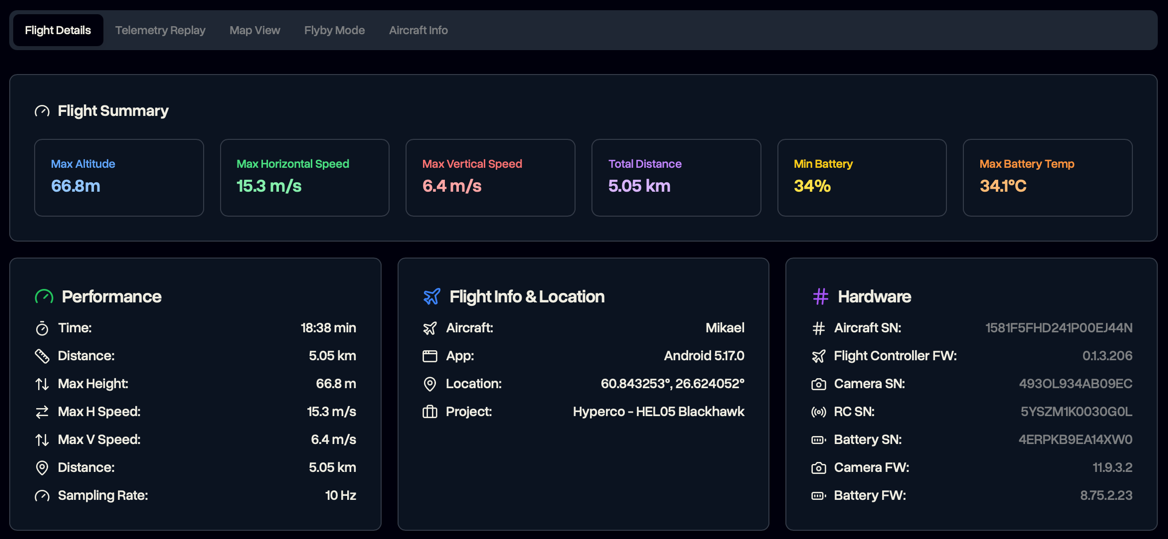
Raw telemetry files contain valuable information, but extracting insights requires proper tools. DJI log analysis capabilities transform binary data into clear, audit-ready documentation that regulators and insurers can evaluate.
Professional log file readers display comprehensive flight information:
- GPS flight paths showing exact routes and positions
- Altitude, speed, and heading throughout the mission
- Battery performance curves indicating system health
- Signal quality and warnings from onboard systems
- Remote controller inputs documenting pilot actions
- Mission parameters and anomalies flagging unusual events
This represents a complete reconstruction of every flight, not just what happened, but how and why. For regulators, this is professional-level detail. For insurers, it is the difference between a smooth claim and a dispute. For operators, it is a foundation for continuous improvement through comprehensive feature sets that enable systematic analysis.
Flight log automation ensures this data flows into analysis tools without manual intervention. The result is operational visibility that supports both compliance and performance optimization.
Automatic log sync: eliminating human error
The weakest point in most compliance chains is human memory. Pilots focus on mission execution, and log management becomes an afterthought. SD cards fill up, transfers get delayed, and records accumulate gaps.
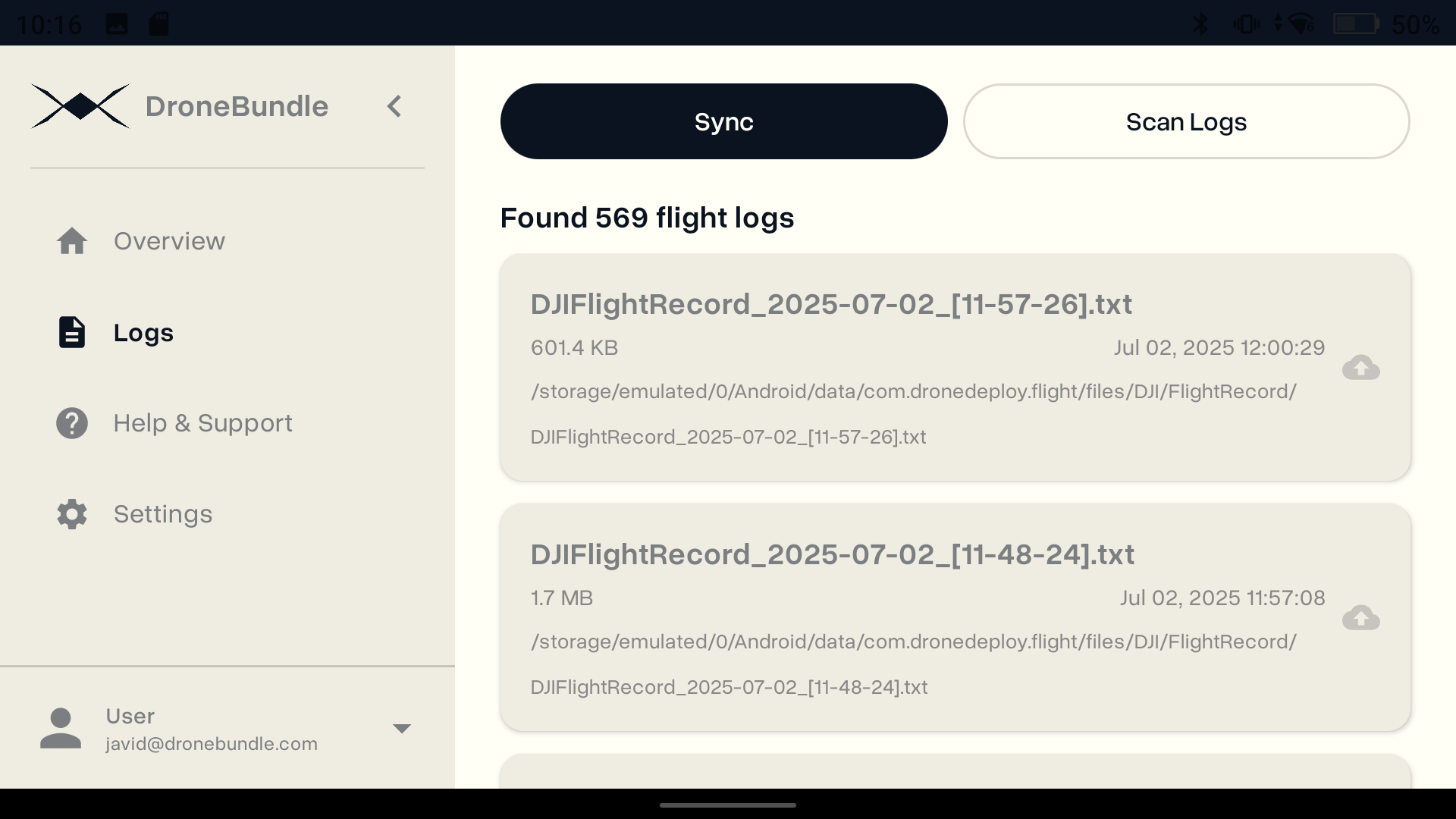
The Android Log Sync App removes this risk by automatically syncing telemetry from DJI Smart Controllers to cloud storage. Every flight uploads without pilot intervention, eliminating the manual steps where data loss typically occurs.
Benefits of automatic syncing include:
- No missed records or lost SD cards from forgotten transfers
- No corrupt file transfers from interrupted uploads
- Complete, secure cloud archive for every flight
- Instant access for audits or investigations
This automation transforms log management from a pilot responsibility into a system guarantee. 3D flight replay extends this visibility after each flight, while automatic archiving ensures historical records remain complete and accessible.
Organizations scaling their operations particularly benefit from automated syncing. As fleet size grows, manual processes become increasingly unreliable. Systematic automation maintains data integrity regardless of operational complexity.
Compliance across continents
Flight log requirements vary by jurisdiction, but the underlying principle remains consistent: operators must demonstrate operational traceability and safety performance.
Part 108 in the United States
Under the FAA's proposed Part 108 framework, especially for BVLOS operations, operators would need to show evidence of:
- System reliability
- Operational traceability
- Safety performance
- Post-flight documentation
The proposed Part 108 regulations would set requirements for both permitted and certificated operations. No final rule has been published, so BVLOS today still runs on waivers and exemptions. Operators pursuing expanded authorizations under either path need organized, audit-ready logs that demonstrate consistent safe operations. The proposed operations supervisor role would be responsible for making sure the operator meets every regulatory requirement, recordkeeping included.
Specific Category in Europe
European drone regulations under the Specific Category require operators to maintain complete documentation. The EASA SORA methodology establishes risk assessment requirements that depend on operational data.
Specific Category compliance requires operators to:
- Maintain complete flight logs
- Provide telemetry for audits
- Demonstrate operational consistency
SORA risk assessments use operational data to establish appropriate mitigations. Operators who can produce comprehensive records demonstrate the consistency regulators expect. Those without systematic log storage face potential delays or additional requirements.
Insurance and operational risk
Flight logs are critical for drone insurance claims. After any incident, from lost aircraft to property damage, insurers rely on telemetry to determine:
- Pilot performance during the event
- Equipment behaviour leading up to the incident
- Environmental factors that may have contributed
Operators who cannot produce logs often face delays, disputes, or outright denials. Insurance adjusters need evidence to process claims efficiently. Complete telemetry provides the factual basis for fair resolution.
Utilities and energy sector operations often involve high-value assets where incident documentation is essential. Power line inspections, substation surveys, and similar missions require comprehensive records that protect both the operator and client.
Beyond claims processing, insurers increasingly consider operational documentation when setting premiums. Operators with systematic log storage demonstrate professional practices that may qualify for better rates. The investment in proper data management often pays for itself through reduced insurance costs.
Building a data-driven operation
Automated log syncing, full telemetry visibility, and audit-ready archives are no longer optional features. They are operational requirements for professional drone programs.
Construction and infrastructure operations exemplify the value of comprehensive flight records. Progress documentation, inspection evidence, and safety compliance all depend on reliable data. Organizations like Mobilysis demonstrate how systematic approaches to data management enable operational excellence.
Operators who embrace systematic log storage position themselves for:
- Expanded authorizations based on documented safety records
- Advanced commercial missions requiring compliance evidence
- Safer and more efficient operations through data analysis
- Competitive advantages in enterprise client relationships
Drone operations software that integrates log storage with broader workflow management creates unified systems for compliance. Flight planning, execution, and documentation connect seamlessly, reducing administrative burden while improving data quality.
Frequently Asked Questions
What flight data should operators store for compliance?
Comprehensive compliance records include GPS tracks, altitude and speed data, battery telemetry, system warnings, and pilot inputs. Pre-flight checklists should also be documented alongside flight telemetry. Most regulators expect records covering the complete flight envelope from takeoff through landing, with sufficient detail to reconstruct operations during audits.
How long should drone flight logs be retained?
Retention requirements vary by jurisdiction and operation type. Part 107 operations typically require records for at least three years, while Specific Category authorizations in Europe may require longer retention. Professional operators often maintain records indefinitely, as historical data supports authorization renewals and demonstrates long-term safety performance.
Can flight logs help reduce insurance premiums?
Insurers increasingly recognize systematic flight documentation as evidence of professional operations. Complete telemetry records support faster claims processing and demonstrate risk management practices. Some insurers offer premium discounts for operators using drone maintenance tracking and comprehensive log storage systems.
What happens if flight logs are incomplete during an audit?
Incomplete records during regulatory audits can result in additional scrutiny, operational restrictions, or compliance findings. For insurance claims, missing data may delay processing or result in unfavorable determinations. Automatic syncing systems prevent these gaps by eliminating manual transfer steps where data loss typically occurs.
Implementation considerations
Organizations building systematic log storage should start with current pain points. Identify where data gaps occur in existing workflows and prioritize automation for those failure modes. Most operators find that automatic syncing addresses the majority of compliance risks.
Integration with existing systems determines implementation complexity. Platforms that connect log storage with flight planning and equipment tracking create unified workflows. Isolated solutions require manual coordination that reintroduces error potential.
Pilot training should accompany system deployment. Even automated systems require proper configuration and occasional verification. Teams need understanding of how data flows from aircraft to archive, and what to check when issues occur.
Storage infrastructure should accommodate growth. Cloud-based systems scale more readily than local solutions, and geographic distribution protects against data loss. Evaluate both current volumes and projected growth when selecting platforms.
In summary
Flight log storage transforms compliance from a documentation burden into a strategic asset. Every flight becomes a proof point, every log a record of safety, reliability, and operational excellence.
Systematic approaches to telemetry collection address the core challenge professional operators face: proving safety when evidence matters most. Automated syncing eliminates the human error that creates compliance gaps. Comprehensive analysis tools extract actionable insights from raw data.
The operators who invest in proper log infrastructure today build the foundation for expanded operations tomorrow. As regulations evolve and client expectations increase, documented safety records become competitive advantages that separate professional operations from casual users.
Ready to Make Every Flight Count?
Professional drone operations require systematic approaches to flight documentation. Automated log syncing, comprehensive telemetry storage, and audit-ready archives protect your operation during regulatory reviews and insurance claims while demonstrating the safety excellence clients expect.
Start your free trial today - no credit card required.
Or book a demo to see how DroneBundle helps teams build verifiable safety records with flight data monitoring and compliance tracking.