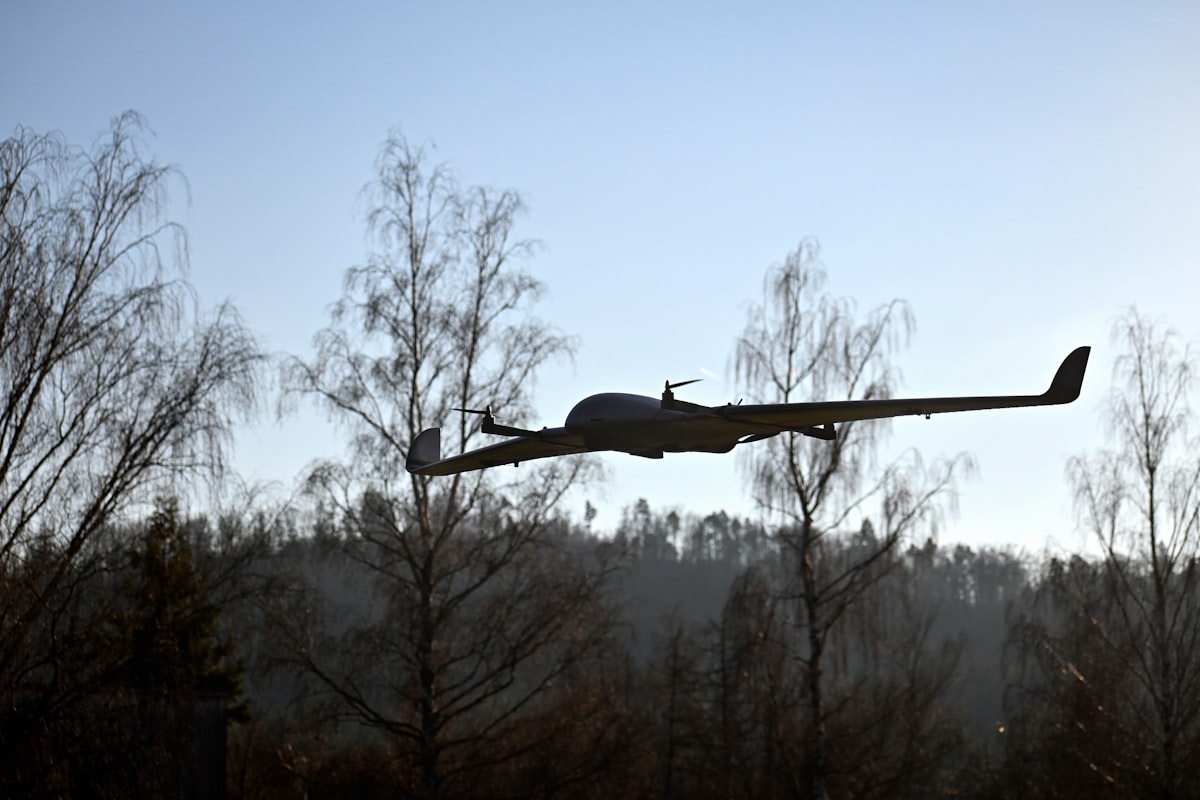
A BVLOS drone is an unmanned aircraft equipped with detect-and-avoid sensors, redundant communication links, and autonomous navigation systems that allow it to fly safely beyond the pilot's direct visual range. Choosing the right BVLOS drone depends on your mission type, regulatory pathway, and operational environment.
Not every drone can fly BVLOS. Plenty of commercial platforms advertise long transmission ranges, but range alone does not make an aircraft BVLOS-capable. The real requirements go deeper: redundant command-and-control links, onboard detect-and-avoid (DAA) systems, fail-safe return behaviors, and compliance with the regulatory framework your operation falls under.
If you are planning beyond visual line of sight operations, the drone you choose will shape everything from your waiver application to your insurance premiums to your daily operational costs. This guide breaks down what actually makes a drone BVLOS-ready, compares the leading platforms in 2026, and covers the full equipment ecosystem you need around the aircraft itself.
What makes a drone BVLOS-capable
A BVLOS-capable drone replaces the pilot's eyes with onboard technology. In standard visual line of sight operations, the pilot watches the aircraft and surrounding airspace directly. When the drone flies beyond that visual range, the aircraft itself must detect other aircraft, avoid obstacles, maintain a reliable data link, and execute fail-safe procedures if something goes wrong.
The FAA's proposed Part 108 framework would set design requirements that BVLOS aircraft must meet. These include the ability to avoid other aircraft, standard Remote ID broadcast, accurate position and navigation, and a safe preset action if the control link times out. The proposal does not list redundant command-and-control links as a stated requirement. European operators working under EASA regulations face similar requirements through the Specific category and SORA methodology.
The key distinction: a drone with a 15 km transmission range is not automatically BVLOS-ready. It needs the safety systems that replace the pilot's visual awareness. Without DAA, redundant comms, and proper fail-safes, regulators will not approve the operation regardless of how far the radio link can reach.
Critical BVLOS drone features
Every BVLOS drone must include six core capabilities to satisfy both regulators and real-world safety requirements. Missing any one of these will likely result in a denied waiver application or, worse, an unsafe operation.
Detect-and-avoid (DAA) systems
DAA is the single most important technology separating a BVLOS drone from a standard commercial platform. These systems must detect both cooperative traffic (aircraft broadcasting ADS-B or transponder signals) and non-cooperative traffic (aircraft with no electronic signature, birds, other drones).
Current DAA approaches include ADS-B In receivers, radar sensors, LiDAR, electro-optical cameras with AI-based detection, and acoustic sensors. The FAA expects BVLOS drones to demonstrate "well clear" separation from other aircraft, which typically means detecting traffic at sufficient range to execute an avoidance maneuver.
No single sensor covers every scenario. The most robust BVLOS platforms combine multiple detection methods for redundancy.
Redundant command-and-control links
If the communication link drops during a BVLOS flight, the pilot has no way to see the aircraft and no way to control it. That scenario demands redundancy. Most BVLOS-capable drones use a primary RF link paired with a cellular (4G/5G) backup, and some add satellite communication as a third layer.
Link latency matters too. The FAA's Part 108 NPRM does not set a bandwidth or latency number. The FAA said industry standards bodies would refine the key link metrics over time, and operators would need to assess how latency and brief link dropouts affect safety. High latency can degrade a pilot's ability to respond to dynamic situations.
Autonomous navigation and fail-safes
BVLOS drones need robust autonomous flight capabilities. GPS/GNSS-based navigation is the baseline, but the aircraft must also handle GPS degradation gracefully. Inertial navigation units (INUs), visual positioning systems, and terrain-following sensors provide backup navigation when satellite signals weaken.
Fail-safe behaviors define what happens when things go wrong. At minimum, a BVLOS drone needs:
- Lost link procedure: Return to home, loiter, or land at a predefined safe point
- Low battery protocol: Automatic return or landing before power becomes critical
- Geofence enforcement: Hard limits that prevent the aircraft from leaving its approved operating area
- DAA-triggered avoidance: Autonomous maneuvers when traffic is detected
Remote ID compliance
All BVLOS drones in the US must broadcast Remote ID information. This is non-negotiable. Under the Part 108 proposal, aircraft would also need standard Remote ID, with an extra status message showing the flight is BVLOS.
Weather resistance
BVLOS missions expose drones to weather conditions the pilot cannot directly observe. An aircraft that handles light rain at the launch site might encounter heavier precipitation 10 km downrange. IP55 or higher ingress protection ratings are standard for serious BVLOS platforms. Wind resistance ratings should exceed the operational maximums you expect to encounter, with margin.
Telemetry and position reporting
Continuous telemetry streaming gives the ground station real-time visibility into aircraft health, position, altitude, speed, battery state, and sensor status. This data stream replaces the situational awareness a pilot normally gets from watching the aircraft. Flight data monitoring becomes even more critical when you cannot see the drone.
Top BVLOS drone platforms in 2026
The BVLOS drone market has matured rapidly. Here are the leading platforms commercial operators are deploying today, organized by form factor.
| Platform | Type | Flight Time | Range | DAA | IP Rating | Approx. Price |
|---|---|---|---|---|---|---|
| Skydio X10 | Multirotor | 40 min | 12 km | AI visual + ADS-B | IP55 | $20,000+ |
| DJI Matrice 350 RTK | Multirotor | 55 min | 20 km | ADS-B In | IP55 | $10,000+ |
| Percepto AIM | Multirotor (dock) | 50 min | 10 km | Full DAA suite | IP55 | $80,000+ (with dock) |
| JOUAV CW-30E | Fixed-wing VTOL | 480 min | 200 km | ADS-B + radar | IP54 | $50,000+ |
| Quantum Trinity F90+ | Fixed-wing VTOL | 90 min | 100 km | ADS-B + optical | IP43 | $25,000+ |
| senseFly eBee X | Fixed-wing | 90 min | 50 km | ADS-B transponder | IP56 | $20,000+ |
Skydio X10 stands out for its AI-powered obstacle avoidance, which uses 360-degree visual sensing to detect and avoid obstacles without relying on cooperative signals. This makes it particularly strong in environments with non-cooperative traffic. Its NightSense system extends operations into low-light conditions.
DJI Matrice 350 RTK offers the longest multirotor flight time and excellent payload flexibility. However, the DJI ban situation in the US creates uncertainty for operators building long-term BVLOS programs around DJI hardware. Check current restrictions before committing.
Percepto AIM is purpose-built for autonomous BVLOS as a drone-in-a-box solution. It handles takeoff, mission execution, landing, and recharging without human intervention. Ideal for recurring infrastructure inspections at fixed sites.
JOUAV CW-30E dominates long-range linear infrastructure work. With an 8-hour endurance and 200 km range, it covers pipeline corridors and power line routes that would require dozens of multirotor flights to complete.
Multirotor vs fixed-wing for BVLOS
The form factor choice is one of the most consequential decisions in a BVLOS program, and it depends entirely on mission profile.
Multirotors excel at localized BVLOS operations: perimeter security, site inspections, drone-in-a-box deployments where the aircraft operates within a 5-10 km radius. They hover, fly slowly for detailed inspections, and operate from confined launch areas. Flight times of 35-55 minutes limit their range, but for many BVLOS use cases, that is sufficient.
Fixed-wing and VTOL hybrids handle linear and large-area BVLOS missions: pipeline corridors, power line inspections, agricultural surveys, and search and rescue over wide areas. Their endurance (1-8 hours) and cruise speeds (60-120 km/h) cover distances that multirotors simply cannot match. The tradeoff is that they cannot hover for detailed inspection and require more complex flight planning.
VTOL hybrids split the difference. They launch and land vertically like a multirotor, then transition to fixed-wing flight for efficient cruise. This eliminates the need for runways or launch equipment while preserving long-range endurance. Most new BVLOS fixed-wing platforms entering the market in 2026 use this configuration.
For operators serving multiple use cases, a mixed fleet often makes the most sense. Use multirotors for close-range autonomous inspections and fixed-wing VTOL for long-range corridor work. Fleet management software becomes essential when coordinating different aircraft types across different mission profiles.
Drone-in-a-box systems for autonomous BVLOS
Drone-in-a-box (DIB) systems represent the most automated form of BVLOS operations. The drone lives in a weatherproof docking station that handles charging, storage, and environmental protection. Missions launch on schedule or on demand, execute autonomously, and the aircraft returns to its dock without any human handling.
This approach is transforming how utilities and energy companies monitor infrastructure. Instead of dispatching a pilot team for each inspection, operators deploy a DIB system at a substation or facility and run daily flights remotely.
Leading DIB platforms include:
- Percepto AIM: The market leader with deployments at energy, mining, and port facilities worldwide. Fully autonomous with thermal and visual inspection capabilities.
- Skydio Dock: Pairs with Skydio X10 for autonomous security patrols and infrastructure monitoring.
- DJI Dock 2/3: Affordable entry point with DJI's ecosystem advantages, though subject to the same regulatory scrutiny as other DJI products in certain markets.
DIB systems typically cost $60,000 to $150,000 including the drone, dock, and software platform. The ROI calculation favors sites with frequent inspection requirements where the alternative is repeatedly mobilizing a pilot crew. A facility running daily drone inspections can break even within 6-12 months compared to manned inspection teams.
The operational complexity shifts from fieldwork to remote management. Pilots become remote supervisors monitoring multiple docked aircraft from a central operations center. This changes staffing requirements, training needs, and the software stack required to track live operations.
The full BVLOS equipment stack
The drone itself is only part of the investment. A production BVLOS operation requires a complete equipment ecosystem.
Ground control station (GCS): The command center for BVLOS flights. This can range from a laptop running manufacturer software to a dedicated multi-screen workstation with redundant communications. For fleet operations, the GCS needs to display live telemetry, airspace status, weather data, and DAA alerts simultaneously.
Communication infrastructure: Beyond the drone's built-in radio, many BVLOS operations require additional ground-based communication nodes to extend range and ensure link redundancy. Cellular network coverage maps become mission planning inputs. Satellite communication modems add weight and cost but provide coverage where cell towers do not reach.
Weather monitoring: BVLOS flights launch into conditions the pilot cannot directly observe at the mission area. Dedicated weather integration tools that provide hyperlocal forecasts along the entire flight corridor are essential. A clear sky at launch does not guarantee safe conditions 20 km away.
Tracking and surveillance radar: Some approved BVLOS operations, particularly those under Part 107 waivers, use ground-based radar to supplement onboard DAA. These systems detect non-cooperative aircraft in the operational area and feed traffic data to the pilot.
Spare parts and maintenance supplies: BVLOS drones accumulate flight hours faster than VLOS aircraft because each mission covers more ground. Maintenance schedules accelerate accordingly. Keep critical spares on hand: propellers, batteries, DAA sensor modules, and communication antennas.
The total cost of a production-ready BVLOS setup, including drone, GCS, communications, and initial spares, typically runs $30,000 to $200,000 depending on platform and mission complexity. Drone-in-a-box deployments land at the higher end. Simple waiver-based operations with visual observers as a backup DAA strategy can start lower.
Insurance and liability for BVLOS drones
BVLOS operations fundamentally change the insurance equation for commercial operators. When a drone flies beyond visual range, the risk profile increases in ways that directly affect coverage requirements and premium costs.
Most drone insurance policies written for VLOS operations exclude or restrict BVLOS flights. You will need a policy that explicitly covers beyond visual line of sight operations, and underwriters will want to see your approved waiver or operational authorization before binding coverage.
Key insurance considerations for BVLOS drone programs:
- Hull coverage increases because BVLOS platforms cost more and face higher loss risk from extended-range operations
- Liability limits should be higher because the drone operates in areas where the pilot cannot visually confirm ground conditions
- Third-party property damage exposure expands with the operational area. A drone flying a 50 km corridor passes over far more property than one operating in a 500-meter radius
- Personal injury coverage must account for the reduced ability to see and avoid people on the ground
- Payload and data coverage becomes relevant for expensive sensor packages and the data they collect
Expect BVLOS insurance premiums to run 2-5x higher than equivalent VLOS coverage. Some operators self-insure hull damage on less expensive platforms and carry only liability coverage to manage costs. Work with a broker who specializes in aviation or drone coverage; general commercial insurance agents rarely understand the nuances.
Managing BVLOS drones at fleet scale
Operating a single BVLOS drone is complex. Operating a fleet of them across multiple sites or mission types multiplies that complexity significantly. The management challenges that fleet operators face in VLOS operations become more intense when aircraft fly beyond visual range.
Concurrent flight monitoring: When multiple BVLOS drones are airborne simultaneously, the operations center needs real-time visibility into every aircraft's position, health, and DAA status. A single pilot supervising multiple autonomous aircraft (which the Part 108 proposal envisions) requires mission planning software that aggregates telemetry, weather, and airspace data into a unified view.
Compliance tracking across platforms: Different BVLOS drones may operate under different authorizations, in different airspace classifications, with different pilot qualifications. Tracking which aircraft is approved for which operation, which pilot holds which authorizations, and which waivers expire when requires systematic compliance management. Spreadsheets break down quickly at fleet scale.
Maintenance intensification: BVLOS aircraft fly more hours per mission and accumulate wear faster. DAA sensors, communication modules, and autonomous navigation systems add maintenance items that standard VLOS drones do not have. Automated maintenance scheduling tied to actual flight hours rather than calendar intervals keeps aircraft airworthy without grounding them prematurely.
Data management: Each BVLOS flight generates significantly more telemetry, imagery, and sensor data than a typical VLOS mission. Processing, storing, and delivering this data requires pipeline automation and adequate storage infrastructure. Flight reporting systems should pull directly from telemetry logs to minimize manual data entry.
A platform like DroneBundle consolidates these management requirements. Flight planning, compliance tracking, fleet maintenance, pilot certifications, and live operations monitoring all feed into a single system. For operators scaling from one or two BVLOS drones to a program running daily autonomous missions, centralized management is not optional. It is the difference between controlled growth and operational chaos.
Regulatory readiness: Part 108 and EASA
The BVLOS drone you buy today must work within the regulatory framework that is emerging now.
FAA Part 108 would be the biggest regulatory shift in US drone operations since Part 107 launched in 2016. The NPRM was published in August 2025, with the comment period reopened through February 2026. No final rule has been published. The draft final rule has been under White House (OIRA) review since July 10, 2026, and no official source gives a publication or effective date.
If finalized, Part 108 would create a standardized pathway for BVLOS compliance and end Part 107 BVLOS waivers. The proposal sets five population density categories and two approval levels: operating permits (lower risk) and operating certificates (higher risk). It covers aircraft up to 1,320 pounds and sets requirements for avoiding other aircraft, Remote ID, and the use of unmanned traffic management services.
Under the proposal, aircraft flown under Part 108 would need FAA airworthiness acceptance, except under a flight test permit. The manufacturer, not the operator, would apply by submitting a declaration of compliance with the design requirements. When choosing a BVLOS drone now, ask the manufacturer whether it plans to seek that acceptance if the rule is finalized. An aircraft without it could not fly under Part 108, and Part 107 BVLOS waivers would no longer be available.
EASA's Specific category governs BVLOS in Europe through the SORA methodology. The process evaluates ground risk and air risk to determine operational approval requirements. European operators should select drones with CE marking and compliance documentation aligned with EASA's technical standards.
Transport Canada has established standardized BVLOS pathways that are more accessible than the FAA's current waiver system. Canadian operators can often achieve BVLOS authorization faster, making Canada an attractive testing ground for new BVLOS programs.
Whichever regulatory environment you operate in, document everything. Risk assessments, pilot qualifications, equipment specifications, and operational procedures must all be current and accessible. Regulators will audit your records, and having a centralized documentation system saves significant time during the approval process.
Frequently asked questions
What is the cheapest BVLOS-capable drone?
The DJI Matrice 30 at approximately $10,000 offers long-range capability and ADS-B In at the lowest price point for a commercial BVLOS platform. However, total program cost including ground station, communications, insurance, and waiver preparation will be significantly higher than the aircraft alone. Budget $30,000 to $50,000 for a basic production-ready BVLOS setup.
Can I use a consumer drone for BVLOS?
Consumer drones lack the detect-and-avoid systems, redundant communication links, and fail-safe behaviors required for BVLOS approval. No consumer platform sold today meets the technical requirements outlined in the FAA's Part 108 NPRM. You need a commercial or enterprise-grade aircraft specifically designed or upgraded for beyond visual line of sight operations.
How far can a BVLOS drone fly?
Range depends entirely on the platform. Multirotors typically operate within 5-20 km for BVLOS missions due to battery limitations. Fixed-wing VTOL drones like the JOUAV CW-30E can cover 200+ km on a single flight. The operational range is also constrained by your communication link reliability and the geographic scope of your regulatory authorization, not just the aircraft's capability.
Do I need a special license to fly BVLOS?
In the US today, flying BVLOS under Part 107 takes a Part 107 certificate plus an approved BVLOS waiver. The pilot certificate is the same, but the waiver is separate and specific to BVLOS. The proposed Part 108 would work differently: its crew roles would not require an FAA-issued airman or remote pilot certificate, and the operator would train and qualify its own staff. In Europe, BVLOS operations fall under EASA's Specific category, which requires an operational authorization based on a SORA assessment. Additional pilot training beyond the basic certification is strongly recommended and may be required by your insurer.
Choosing the right BVLOS drone is about matching aircraft capabilities to your specific mission requirements, regulatory environment, and growth trajectory. The technology is mature enough for production operations today. Part 108 is still a proposal, and no official source gives a date for a final rule, so plan around today's waiver and exemption routes.
If you are building or scaling a BVLOS program, the operational management layer matters as much as the aircraft choice. Start a free trial with DroneBundle to see how centralized flight planning, compliance tracking, and fleet management simplify BVLOS operations. Or book a live demo to walk through your specific use case with our team.